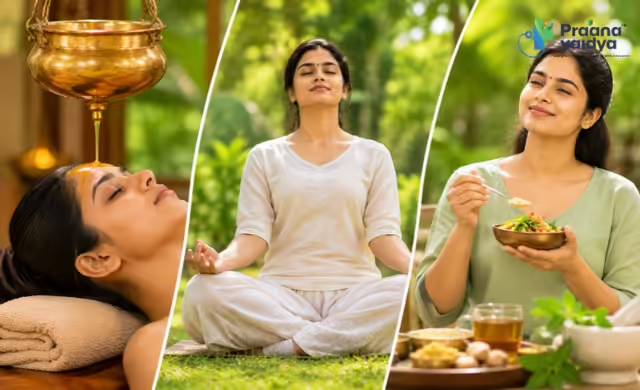
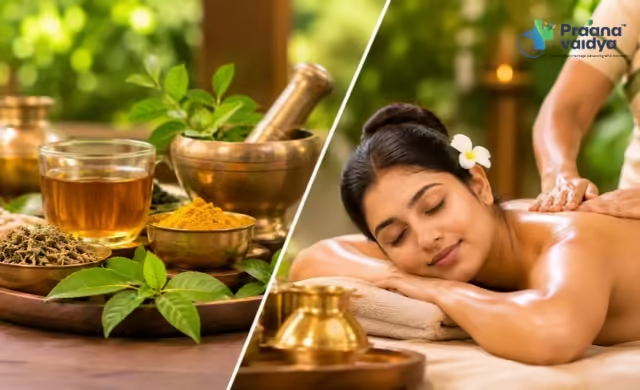
Ayurveda is often described as a holistic system because its approach can involve more than one type of therapy. Depending on the individual’s needs and the practitioner’s assessment, an Ayurvedic care plan may include internal and external Ayurvedic treatment rather than relying on one approach alone.
Internal approaches generally involve things taken or followed internally, such as prescribed Ayurvedic formulations, dietary guidance, and lifestyle recommendations. External approaches involve therapies applied to or performed on specific areas of the body, such as Abhyanga and other traditional procedures.
Understanding the difference helps you make sense of why an Ayurvedic consultation may include several components instead of a single procedure.
At Praanavaidya, Ayurvedic care is approached through consultation and individual assessment, with therapies selected according to the person’s requirements.
Want to understand which Ayurvedic approach may be suitable for you?
What Is Internal and External Ayurvedic Treatment?
The terms “internal” and “external” describe two broad ways Ayurvedic therapies and recommendations can be used.
Internal Ayurvedic Treatment
Internal approaches refer to practices and formulations taken or followed internally. Depending on the consultation and treatment plan, these may include:
- Prescribed Ayurvedic formulations
- Dietary recommendations
- Daily routine guidance
- Lifestyle recommendations
- Specific internal procedures used within an Ayurvedic treatment plan
- Preparatory approaches associated with certain Panchakarma programmes
The exact approach can vary from one person to another. Ayurveda traditionally places importance on selecting therapies according to an individual’s overall assessment rather than following the same routine for everyone.
External Ayurvedic Treatment
External approaches involve therapies performed on the body or specific body areas. Examples include:
- Abhyanga
- Kati Basti
- Greeva Basti
- Janu Basti
- Udvartana
- Swedana
- Shirodhara
- Localised oil applications
- Other practitioner-guided external procedures
Each therapy has its own method, materials, duration, and procedure. Some are performed over the whole body, while others focus on a particular area.
Why Does Ayurveda Use Both Internal and External Approaches?
A common question is why an Ayurvedic plan might include both internal and external therapies.
The simple answer is that they represent different parts of the traditional Ayurvedic approach.
An internal approach focuses on what is administered or followed internally, while an external approach focuses on procedures performed on the body.
Using both does not mean that every person needs every therapy. Instead, the combination can depend on the purpose of the consultation, the individual’s requirements, the practitioner’s assessment, and the overall treatment plan.
Different Therapies Can Have Different Roles
One Ayurvedic therapy should not automatically be considered interchangeable with another.
For example, Abhyanga is a traditional oil-based massage procedure, while Kati Basti involves retaining warm oil over a defined area around the lower back. Similarly, Greeva Basti and Janu Basti refer to localised procedures involving the neck and knee regions respectively.
The names may sound similar, but the procedures themselves are different.
This is why understanding the therapy matters instead of choosing a procedure simply because it is popular or frequently discussed online.
Internal vs External Ayurvedic Treatment: Understanding the Difference
The easiest way to understand the distinction is to look at how each approach is delivered.
Internal Approach
An internal approach may involve:
- Formulations taken internally
- Dietary instructions
- Lifestyle guidance
- Practitioner-directed internal procedures
- Preparatory steps for selected Ayurvedic programmes
External Approach
An external approach may involve:
- Oil application
- Massage-based procedures
- Localised therapies
- Herbal powder applications
- Steam or fomentation-based procedures
- Area-specific Ayurvedic therapies
The two categories can therefore be different in method even when they form part of the same overall Ayurvedic plan.
Does Every Ayurvedic Treatment Need Both?
No.
It would be inaccurate to assume that every person requires both internal and external therapies.
Ayurveda involves individual assessment, and the treatment plan can depend on factors discussed during consultation. A practitioner may recommend one approach, a combination of approaches, or a phased plan.
The decision should therefore come from a qualified Ayurvedic practitioner rather than from a generic online treatment list.
Why Consultation Matters
An Ayurvedic consultation provides an opportunity to discuss:
- Your primary concerns
- Existing routines
- Dietary and lifestyle habits
- Previous therapies
- Current medications or supplements
- Relevant medical history
- Your expectations from Ayurvedic care
This information helps the practitioner understand the context before suggesting a suitable approach.
Examples of External Ayurvedic Therapies
Several traditional external therapies are commonly discussed in Ayurveda. Understanding what they involve can help users distinguish them from one another.
Abhyanga
Abhyanga is a traditional Ayurvedic oil massage procedure. It involves the application of oil through a structured massage process.
The type of oil, duration, technique, and frequency can vary according to the practitioner and the treatment plan.
Kati Basti
Kati Basti is a localised Ayurvedic procedure in which warm oil is retained within a specially prepared boundary over the lower-back region for a defined period.
It is different from a full-body massage because the method and area of application are specific.
Greeva Basti
Greeva Basti is another localised procedure involving the retention of warm oil over the neck region.
Although it shares the word “Basti” with other Ayurvedic procedures, its method is different from Basti Karma.
Janu Basti
Janu Basti is a localised procedure involving the retention of warm oil around the knee region.
Understanding these distinctions is particularly important because Basti Karma, Kati Basti, Greeva Basti, and Janu Basti are not the same procedure.
How Internal and External Approaches May Fit Into One Plan
An Ayurvedic treatment plan can contain several stages.
For example, a practitioner may first conduct a consultation and assessment, followed by recommendations involving diet, routine, internal formulations, or external therapies.
The sequence depends on the individual plan.
A useful way to think about it is:
Consultation → Assessment → Treatment Planning → Selected Internal and/or External Therapies → Follow-up
This approach keeps the focus on the person’s requirements rather than treating a therapy as a one-size-fits-all solution.
If you are unsure whether an internal approach, external therapy, or a combination is appropriate for you, speak with a Praanavaidya Ayurvedic practitioner before choosing a procedure.
What Should You Ask Before Starting an Ayurvedic Therapy?
Before beginning any Ayurvedic programme, it is useful to understand exactly what has been recommended.
Consider asking:
- What is the name of the therapy?
- Is it an internal or external approach?
- What does the procedure involve?
- How long does each session take?
- How many sessions are being suggested?
- Are there dietary or routine instructions to follow?
- Are there preparation or follow-up requirements?
- What should you tell the practitioner about existing medicines or supplements?
- Who will supervise the therapy?
Clear communication can help you understand what to expect from the process.
Internal and External Ayurvedic Treatment at Praanavaidya
Praanavaidya offers Ayurvedic consultation and therapy services across multiple locations, including Bangalore, Hubballi, Mangalore, Mumbai, Delhi, and Lucknow.
Rather than selecting a therapy based only on a symptom or an online search, patients can begin with a consultation and discuss their individual requirements with an Ayurvedic practitioner.
The focus is on understanding the difference between therapies and choosing an appropriate approach through consultation.
Final Thoughts
Internal and external Ayurvedic treatment refers to two different components of the broader Ayurvedic approach.
Internal approaches may involve formulations, dietary guidance, lifestyle recommendations, or other practitioner-directed procedures. External approaches may include therapies such as Abhyanga, Kati Basti, Greeva Basti, Janu Basti, Udvartana, and other traditional procedures.
The important point is that these approaches are not interchangeable, and not every person needs the same combination.
Understanding what a therapy involves, why it has been included in a plan, and how it fits into the overall approach can make an Ayurvedic consultation more meaningful.
Looking for Ayurvedic consultation? Connect with Praanavaidya to discuss your requirements and understand the available Ayurvedic treatment approaches.
Visit Praanavaidya at your nearest branch:
Rajajinagar- 08065903133
Hubballi – 08065903145
Indiranagar- 08065903135
Mumbai-08065903118
Yelahanka- 08065903134
Mangaluru-08065903136
Jayanagar- 08065903132
Delhi-08065903140
Lucknow-08065903130
FAQs
What is internal Ayurvedic treatment?
Internal Ayurvedic treatment refers to Ayurvedic approaches administered or followed internally. Depending on the individual plan, this may include prescribed formulations, dietary guidance, lifestyle recommendations, or specific internal procedures.
What is external Ayurvedic treatment?
External Ayurvedic treatment refers to therapies performed on the body or specific body areas. Examples include Abhyanga, Kati Basti, Greeva Basti, Janu Basti, Udvartana, and other traditional external procedures.
What is the difference between internal and external Ayurvedic treatment?
The main difference is how the approach is delivered. Internal approaches involve something taken or followed internally, while external approaches involve procedures performed on the body or a specific body region.
Is Abhyanga an internal or external Ayurvedic treatment?
Abhyanga is an external Ayurvedic procedure involving the application of oil through a traditional massage process.
Are Kati Basti and Basti Karma the same?
No. Despite sharing the word “Basti,” they refer to different Ayurvedic procedures. Kati Basti is a localised external procedure involving warm oil, while Basti Karma is a distinct Ayurvedic procedure that involves administering prescribed formulations through the rectal route.
Does everyone need both internal and external Ayurvedic treatment?
No. Ayurvedic treatment plans can vary between individuals. The choice of internal therapies, external therapies, or a combination depends on the practitioner’s assessment and the individual’s requirements.
Why is Ayurvedic consultation important before choosing a therapy?
A consultation allows the practitioner to understand the individual’s concerns, routines, history, and other relevant information before discussing an appropriate Ayurvedic approach.
Can internal and external Ayurvedic therapies be part of the same treatment plan?
Yes, they can be included within the same Ayurvedic plan when the practitioner considers both approaches appropriate for the individual.
Praanavaidya
Healthcare Professional
Focused on patient-centric care and evidence-based treatment plans.
More from Praanavaidya