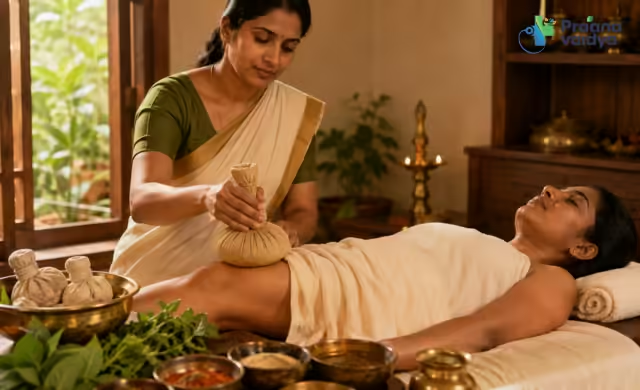
Joint discomfort can affect movement, flexibility, and everyday activities. Alongside modern approaches to joint care, Ayurveda has traditionally used several external therapies to support comfort and mobility. One of these is Upanaha Sweda, a form of Ayurvedic warm poultice therapy.
Upanaha involves preparing a warm medicinal paste or poultice and applying it over a selected area. The preparation is traditionally kept in place for a prescribed period, allowing warmth and the properties of the selected ingredients to act locally.
Unlike a simple hot-water bag or heating pad, Upanaha Sweda is a medicated warm application in which the ingredients, temperature, preparation method, duration, and application site are selected according to the individual’s condition.
It is traditionally considered particularly relevant to conditions involving stiffness, discomfort, heaviness, and restricted movement.
At Praanavaidya, consultation can help determine whether traditional therapies such as Upanaha Sweda are appropriate for an individual’s joint or musculoskeletal concerns.
What Is Upanaha Sweda?
The term Upanaha refers broadly to a medicinal poultice or application, while Sweda relates to therapeutic sweating or sudation in Ayurveda.
Upanaha Sweda is therefore a traditional therapy that combines:
- Medicinal ingredients
- Warmth
- Local application
- A period of retention
The ingredients may be prepared into a paste or poultice and applied to the affected region.
The therapy is different from simply applying heat because the Ayurvedic formulation is an important part of the procedure.
How Does Upanaha Sweda Work Traditionally?
Ayurveda traditionally uses therapeutic warmth to address certain conditions associated with stiffness, discomfort, and restricted movement.
Warmth may help create a soothing sensation around tense or stiff areas.
The selected medicinal ingredients are also traditionally chosen according to the individual’s condition and Ayurvedic assessment.
The overall process may involve:
Assessment → Selection of ingredients → Preparation → Warm application → Retention → Removal → Post-treatment care
The exact method can vary.
What Ingredients Are Used in Upanaha?
There is no single universal Upanaha formulation.
Depending on the condition and traditional treatment plan, preparations may include combinations of:
- Herbal powders
- Leaves
- Roots
- Seeds
- Oils
- Ghee
- Grains or flour
- Other traditional medicinal substances
The selection depends on factors such as:
- Location of discomfort
- Nature of symptoms
- Swelling or stiffness
- Individual constitution
- Current Dosha considerations
- Skin sensitivity
- Season
Because the ingredients can differ significantly, Upanaha should ideally be administered according to professional guidance rather than prepared randomly at home.
What Happens During an Upanaha Sweda Session?
The exact procedure can vary according to the practitioner and treatment plan.
Generally, the process may involve several steps.
1. Assessment
The practitioner first evaluates the affected area and considers the individual’s symptoms and health history.
2. Preparation of the Poultice
Selected herbs and other ingredients are combined according to the traditional formulation.
3. Warming the Preparation
The mixture is brought to an appropriate warm temperature.
It should be comfortably warm rather than excessively hot.
4. Local Application
The prepared medicinal mixture is applied over the selected joint or body region.
5. Covering the Area
The poultice may be covered with an appropriate material to help retain warmth and keep the preparation in place.
6. Retention
It is left in position for a prescribed period.
7. Removal
The application is carefully removed after the recommended duration.
8. Post-Treatment Care
The area may be cleaned and the patient may be advised on appropriate activity or rest.
Which Joints May Be Considered for Upanaha?
Upanaha Sweda is traditionally used as a local therapy and may be considered for areas such as:
- Knee
- Shoulder
- Elbow
- Ankle
- Wrist
- Other selected joints
Its suitability depends on the underlying condition.
For example, joint pain caused by an injury, infection, fracture, or another serious condition may require a completely different approach.
Therefore, the location of pain alone is not enough to determine whether Upanaha is appropriate.
Why Is Upanaha Used for Joint Stiffness?
Warmth is traditionally considered useful for conditions characterised by stiffness and reduced mobility.
A warm application can feel soothing around tense areas and may make movement more comfortable temporarily.
From an Ayurvedic perspective, Upanaha may be considered when qualities such as:
- Coldness
- Stiffness
- Dryness
- Tightness
- Local discomfort
are prominent.
However, these are traditional Ayurvedic concepts and should not be interpreted as modern medical diagnoses.
Upanaha Sweda and Joint Pain
Joint pain can have many different causes.
Examples include:
- Osteoarthritis
- Rheumatoid arthritis
- Sports injuries
- Tendon problems
- Bursitis
- Gout
- Ligament injuries
- Infections
- Fractures
Upanaha may be considered as a supportive traditional therapy for selected musculoskeletal conditions.
It should not be assumed that every type of joint pain is suitable for heat therapy.
A correct diagnosis is important before beginning treatment.
Traditional Ayurvedic Benefits of Upanaha Sweda
Ayurvedic practice traditionally associates Upanaha Sweda with several supportive effects.
Helps Provide Local Warmth
The warm poultice provides sustained warmth to the selected area.
Supports Comfort
The combination of warmth and local application may provide a soothing sensation.
May Help With Stiffness
Warmth is traditionally used when stiffness and restricted movement are prominent.
Supports Mobility
When stiffness is reduced, movement may feel more comfortable.
Provides Localised Therapy
Unlike whole-body therapies, Upanaha is directed toward a specific area.
These should be understood as traditional therapeutic uses rather than guarantees of medical outcomes.
Upanaha Sweda vs a Regular Warm Compress
Although both involve warmth, they are not exactly the same.
| Upanaha Sweda | Regular Warm Compress |
| Uses a medicinal preparation | Usually uses only heat |
| Ingredients are selected traditionally | Usually no herbal formulation |
| Applied locally | Applied locally |
| Preparation varies according to condition | Usually standard |
| Traditionally administered as a therapy | Common home-care measure |
| May involve a retention period | Usually applied for a short period |
The key difference is the medicated Ayurvedic formulation combined with therapeutic warmth.
Final Takeaway
Upanaha Sweda is a traditional Ayurvedic warm poultice therapy that combines local heat with a selected medicinal preparation. Unlike a standard heating pad or warm towel, the therapy involves choosing ingredients and a method according to the individual’s condition.
It is traditionally used for selected musculoskeletal concerns involving stiffness, discomfort, heaviness, and restricted movement. The therapy may be considered for areas such as the knee, shoulder, elbow, wrist, or ankle when appropriate.
However, joint pain and swelling can have many causes. Heat is not suitable for every condition, and sudden swelling, severe pain, fever, injury, or unexplained symptoms should receive appropriate medical evaluation.
At Praanavaidya, consultation can help determine whether Upanaha Sweda is appropriate and how it can fit into an individualised Ayurvedic approach to joint and musculoskeletal care.
Visit Us in-
Rajajinagar- 08065903133
Hubballi – 08065903145
Indiranagar- 08065903135
Mumbai-08065903118
Yelahanka- 08065903134
Mangaluru-08065903136
Chamrajpet-08065903132
Delhi-08065903140
Lucknow-08065903130
Frequently Asked Questions
What is Upanaha Sweda?
Upanaha Sweda is a traditional Ayurvedic therapy involving the application of a warm medicinal poultice to a selected area of the body.
What is Upanaha used for?
It is traditionally used as a local therapy for conditions involving stiffness, discomfort, and restricted movement, particularly in selected musculoskeletal complaints.
Is Upanaha Sweda the same as a hot compress?
No. A regular hot compress mainly provides heat, whereas Upanaha involves a specially prepared medicinal poultice combined with warmth.
Can Upanaha be used for knee pain?
It may be considered for selected causes of knee discomfort and stiffness. The underlying cause should be assessed before using warming therapy.
Can Upanaha reduce joint stiffness?
Warmth may provide temporary comfort and make movement feel easier. Ayurveda traditionally uses Upanaha for selected stiffness-related presentations.
How long should an Upanaha poultice remain on the joint?
There is no standard duration for everyone. The retention time depends on the preparation and the individual’s condition and should follow professional guidance.
Is Upanaha suitable for acute swelling?
Not necessarily. The cause of swelling should be assessed first. Sudden, severe, red, hot, or painful swelling requires appropriate medical evaluation.
How often should Upanaha be done?
Frequency varies according to the individual’s condition, formulation, response, and practitioner recommendations.
Praanavaidya
Healthcare Professional
Focused on patient-centric care and evidence-based treatment plans.
More from Praanavaidya