
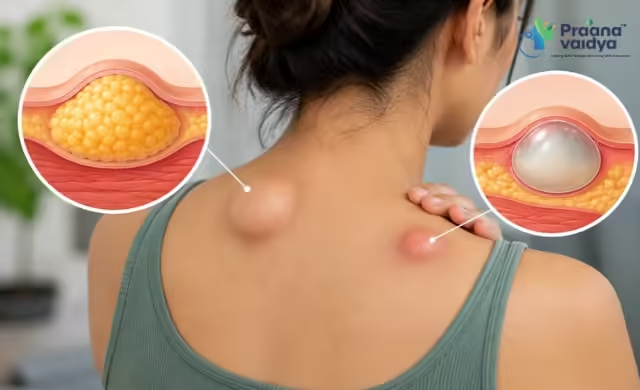
Finding a lump under the skin can immediately make you wonder what it is. Two possibilities people commonly search for are a lipoma or cyst. Because both can appear as rounded lumps beneath the skin, it is easy to assume that they are the same.
The difference between a lipoma and a cyst is mainly related to what lies beneath the skin. However, appearance and touch alone are not always enough to identify a lump accurately.
In this guide, Praanavaidya explains the common differences between a lipoma and a cyst, the clues doctors consider during an assessment, and why a new or changing lump should not be identified through self-examination alone.
Not sure whether a lump is a lipoma or cyst?
What Is a Lipoma?
A lipoma is a lump formed from fatty tissue beneath the skin. It may appear as a rounded or oval swelling and can occur in different areas of the body.
People often notice a lipoma because of its shape or because they can feel a soft lump beneath the skin. However, the way a lump feels can vary depending on its size, depth and location.
Common areas where people may notice a lump include:
- Arms
- Shoulders
- Back
- Neck
- Thighs
- Torso
The location alone does not establish whether a lump is a lipoma. Other features need to be considered as part of an assessment.
What Is a Cyst?
A cyst is a closed, sac-like structure that can occur in or beneath the skin. Different types of cysts can have different appearances and characteristics.
Some skin cysts may appear as smooth, rounded lumps. In some cases, the skin over the lump may look different from the surrounding area, and some cysts may have a visible opening on the surface.
Because the word “cyst” covers different types of lumps, a doctor considers the location, appearance, texture and other features rather than relying on the name alone.
Lipoma vs Cyst: Key Differences
When comparing a lipoma vs cyst, doctors may consider several physical characteristics.
| Feature | Lipoma | Cyst |
| Basic structure | Lump involving fatty tissue | Sac-like structure beneath or within the skin |
| Feel | Often soft or rubbery | May feel firmer or more rounded |
| Movement | May move slightly beneath the skin | Movement can vary depending on the type and location |
| Skin appearance | Skin may appear unchanged | Some cysts may have a visible surface opening or skin change |
| Surface discharge | Usually not associated with surface discharge | Some skin cysts may release material |
| Tenderness | May or may not be tender | May or may not be tender |
| Appearance | Often appears as a smooth, rounded swelling | Often appears as a rounded or raised lump |
These are general clues rather than a checklist for self-diagnosis. Two different types of lumps can sometimes look or feel similar.
How Doctors Tell the Difference Between a Lipoma and Cyst
Doctors do not usually depend on one characteristic when assessing a lump. Instead, they consider several details together.
1. They ask about the lump’s history
The first step may involve questions about when the lump was noticed and whether it has changed.
A doctor may ask:
- How long has the lump been present?
- Has its size changed?
- Has the shape changed?
- Has the lump become uncomfortable?
- Has the skin over it changed?
- Has there been any discharge?
- Have you noticed any other lumps?
The answers provide useful context for the physical examination.
2. They examine the location
The location of a lump can provide context, but it does not confirm whether it is a lipoma or cyst.
Doctors may look at whether the lump is just beneath the skin or appears to sit deeper. They also consider its size and relationship to the surrounding tissue.
3. They assess the texture
The way a lump feels during examination can provide useful information.
A lipoma may feel soft or rubbery, while a cyst may feel more rounded or firm. However, these descriptions can overlap.
This is one reason why searching for “what does a lipoma feel like” or “what does a cyst feel like” cannot replace an examination.
4. They check whether the lump moves
Movement beneath the skin can be another clue.
A doctor may gently examine the lump to understand how it moves in relation to the surrounding tissue. The amount of movement can vary depending on the size, depth and location of the lump.
5. They look at the skin over the lump
The skin itself can provide additional information.
A doctor may check whether the skin looks normal or whether there is a visible opening, redness, swelling or another change.
A surface opening can be relevant when considering certain types of skin cysts, but its presence or absence should not be used by itself to identify a lump.
6. They decide whether further evaluation is needed
Sometimes a physical examination provides enough information to guide the next step. In other situations, the nature of a lump may not be clear from examination alone.
Depending on the individual situation, a doctor may consider additional evaluation or imaging to understand the lump more clearly.
The important point is that lipoma vs cyst is not always a question that can be answered reliably by looking at a photograph or feeling the lump yourself.
Can You Tell If a Lump Is a Lipoma or Cyst by Touch?
Touch can provide clues, but it cannot always provide an answer.
For example, a soft lump may make someone think “lipoma”, while a rounded lump beneath the skin may lead someone to think “cyst”. Both assumptions can be misleading because different lumps can have overlapping characteristics.
Instead of asking only whether a lump feels soft, consider the bigger picture:
- When did you first notice it?
- Has it changed?
- Is the size different from before?
- Has the skin changed?
- Is there any discharge?
- Has the texture changed?
- Has it become uncomfortable?
These details can be useful when discussing the lump with a healthcare professional.
When Should a New or Changing Lump Be Assessed?
A new lump does not automatically indicate a particular condition. However, a lump that is changing deserves attention rather than being identified based only on appearance.
Consider discussing a lump with a healthcare professional if you notice:
- A new unexplained lump
- A noticeable change in size
- A change in shape or texture
- Persistent discomfort or tenderness
- Changes in the skin over the lump
- Discharge from the surface
- A lump that feels different from before
- A lump whose nature you cannot identify
The purpose of assessment is to understand what the lump represents before deciding what, if anything, needs to be done next.
If you have noticed a lump and are unsure whether it resembles a lipoma or cyst, you can contact Praanavaidya to discuss your concern and arrange an assessment.
What Happens After a Lump Is Identified?
Once a doctor has assessed the lump, the next step depends on what was found.
Some situations may only require observation or follow-up, while others may require additional evaluation. If the findings are uncertain, further investigation may be considered.
This is why it is useful to separate two questions:
“Does this look like a lipoma or cyst?”
and
“What is the appropriate next step for this particular lump?”
The second question cannot always be answered from appearance alone.
For people searching for lipoma vs cyst, the most useful takeaway is simple: the two can look similar, but their underlying structure is different, and a proper assessment is more reliable than self-diagnosis.
Lipoma vs Cyst: What Should You Remember?
A lipoma and a cyst can both appear as lumps beneath the skin, which is why they are often confused.
The main differences doctors consider include:
- What the lump appears to be made of
- Its texture
- Its movement
- Its location
- The appearance of the overlying skin
- Whether there is a surface opening or discharge
- Whether the lump has changed over time
- Whether further assessment is necessary
No single feature should be treated as a definite answer.
If you have a new, unexplained or changing lump, getting it assessed can help clarify what you are dealing with rather than relying on online descriptions or self-examination.
Visit Us in-
Rajajinagar- 08065903133
Hubballi – 08065903145
Indiranagar- 08065903135
Mumbai-08065903118
Yelahanka- 08065903134
Mangaluru-08065903136
Jayanagar- 08065903132
Delhi-08065903140
Lucknow-08065903130
FAQs
What is the main difference between a lipoma and a cyst?
A lipoma is a lump involving fatty tissue, while a cyst is a sac-like structure that can occur beneath or within the skin. Their appearance and feel can overlap, so an assessment may be needed to distinguish them.
How can you tell if a lump is a lipoma or cyst?
Doctors may consider the lump’s location, texture, movement, skin appearance, history and changes over time. These features can provide clues, but they do not always establish the nature of a lump by themselves.
Is a lipoma usually soft or hard?
A lipoma may feel soft or rubbery. However, texture can vary, so a soft lump should not automatically be assumed to be a lipoma.
What does a cyst feel like under the skin?
A skin cyst may feel rounded or firm, although the exact texture can vary depending on the type and location. Touch alone cannot reliably identify every cyst.
Can a cyst and lipoma look the same?
Yes, some lumps can have similar external appearances. This is why doctors consider several features rather than relying only on how a lump looks.
When should a lump under the skin be checked?
A new unexplained lump, or one that changes in size, shape, texture or appearance, can be discussed with a healthcare professional for appropriate assessment.
Can a doctor tell the difference between a lipoma and cyst during an examination?
An examination can provide useful clues about the nature of a lump. If the findings are not clear, additional evaluation may be considered.
Should I diagnose a lipoma or cyst based on pictures online?
No. Online photographs and descriptions can help you understand general differences, but they cannot establish what a particular lump is. An appropriate assessment is more useful when the nature of a lump is uncertain.
Praanavaidya
Healthcare Professional
Focused on patient-centric care and evidence-based treatment plans.
More from Praanavaidya