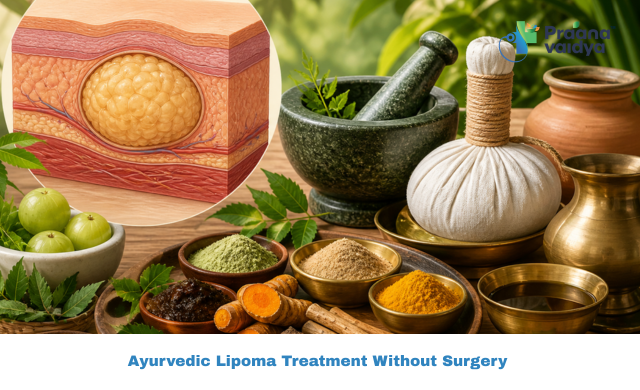
Soft, painless lumps under the skin can feel unsettling — but Ayurveda has addressed this condition for thousands of years. Understand the Ayurvedic approach to lipoma care, what a consultation may involve, and the limitations of available evidence.
At Praanavaidya, we use natural therapies in a way that’s simple and practical for today’s lifestyle. Instead of just removing the lump, our experts try to understand why it formed in the first place — looking at your digestion, daily habits, and overall body balance. Based on this, we create a personalized plan using natural herbs, therapies, and easy lifestyle changes to discuss suitable care options, individual health needs and follow-up after confirming the diagnosis.
📞 Call / WhatsApp: 08065903127 | +91 96117 73811
What Is a Lipoma? Understanding the Condition
A lipoma is a slow-growing, benign (non-cancerous) lump of fatty tissue that develops between the skin and the underlying muscle layer. These lumps are typically:
- Soft and doughy to the touch
- Movable when pressed with a finger
- Painless, unless they press on nearby nerves
- Small in size, usually between 1–3 cm, though some grow larger
Lipomas most commonly appear on the neck, shoulders, back, abdomen, arms, and thighs. While conventional medicine often monitors or surgically removes them, Ayurvedic practitioners may consider constitution, digestion and daily habits when discussing care. These traditional concepts should be distinguished from established evidence about lipoma treatment.
Arrange a medical assessment for a new or unexplained lump, particularly if it grows, becomes painful, feels hard or fixed, or becomes red or hot to touch.
Ayurvedic Treatment for Lipoma: A Multi-Layered Approach
PraanaVaidya’s Ayurvedic protocol for lipoma treatment combines classical Ayurvedic principles with personalised care across four pillars:
1. Internal Herbal Medicines
An Ayurvedic practitioner may discuss herbal formulations based on an individual assessment. The expected benefit, supporting evidence, possible side effects and medicine interactions should be explained before prescribing.
2. External Therapies
Topical Ayurvedic treatments directly target the lump while promoting local circulation:
Lepa (Herbal Paste Application)
Lepa involves applying a prepared herbal paste to the skin. Its traditional use does not establish that it can dissolve a lipoma. Suitability and the possibility of skin irritation should be discussed with the practitioner.
Kshara Karma
Application of specially prepared alkaline herbal preparations (Kshara) that chemically reduce the lipoma tissue without surgical incision. This is an advanced classical Ayurvedic procedure.
3. Panchakarma Detoxification Therapies
For deep-rooted or multiple lipomas, Panchakarma therapies address the systemic Kapha and Ama accumulation:
Virechana (Therapeutic Purgation)
Medicated purgation clears accumulated Pitta and Ama from the GI tract, improving Agni and metabolic efficiency — reducing the body’s tendency to form fatty deposits.
Udvartana (Herbal Powder Massage)
Dry powder massage using Kapha-reducing herbs (like Triphala powder, Haridra, and Mustard) performed in a direction opposite to hair follicles. This stimulates lymphatic drainage, metabolises subcutaneous fat, and improves skin and tissue health.
Basti (Medicated Enema)
Tikta (bitter) herbal enemas cleanse the deeper Dhatus and regulate Vata, which governs the direction of metabolic processes — supporting the breakdown of accumulated fat tissue.
4. Diet & Lifestyle
Ayurveda emphasises that no treatment works in isolation from diet and lifestyle:
Foods to favour:
- Light, warm, and dry foods
- Bitter vegetables (karela, methi)
- Ginger, black pepper, turmeric in daily cooking
- Barley (Yava) — highly recommended in classical texts for Kapha conditions
- Warm herbal teas (ginger, fennel, cumin)
Foods to avoid:
- Cold, heavy, oily, and processed foods
- Excessive dairy (especially cheese, ice cream)
- Refined sugar and white flour
- Excessive red meat
Lifestyle recommendations:
- Regular brisk walking or aerobic activity (minimum 30 minutes daily)
- Dry brushing or self-massage with mustard or sesame oil
- Avoid sleeping during the day (Divaswapna aggravates Kapha)
- Practice pranayama — specifically Kapalabhati and Bhastrika for metabolic stimulation
These procedures may be discussed within traditional Ayurvedic practice. Their suitability, risks and evidence for the intended outcome require individual assessment.
How Long Does Ayurvedic Treatment for Lipoma Take?
The duration of a proposed care plan depends on the individual assessment and its intended goals. A fixed timeline for lipoma reduction should not be promised. Before starting, discuss how progress will be measured, when the plan will be reviewed and what happens if there is no measurable benefit.
Can Ayurveda Prevent Lipoma Recurrence?
Ayurvedic care should not be presented as a guaranteed way to prevent lipoma recurrence. A lump returning at a previous removal site and a new lump developing elsewhere are different situations. Lipomas typically do not return after removal, although another lump can develop and should be assessed.
Read more about recurring lipomas and the Ayurvedic perspective.
Why Choose PraanaVaidya for Lipoma Treatment?
At PraanaVaidya, we combine the depth of classical Ayurvedic science with the precision of modern diagnostic understanding. Our approach to lipoma treatment is:
- 100% personalised based on Prakriti assessment
- Rooted in classical Ayurvedic texts — not commercial shortcuts
- Supervised by experienced Ayurvedic physicians with expertise in Granthi Chikitsa
- Supported by guided diet and lifestyle plans throughout treatment
- Available via online and in-person consultation
Explore lipoma consultation and care at Praanavaidya.
Our Branches
Rajajinagar- 08065903133
Hubballi – 08065903145
Indiranagar- 08065903135
Mumbai-08065903118
Yelahanka- 08065903134
Mangaluru-08065903136
Chamrajpet-08065903132
Frequently Asked Questions (FAQs)
Q1. Can Ayurveda completely cure a lipoma without surgery?
Ayurvedic treatment should not be described as a proven or guaranteed cure without reliable evidence for the specific treatment. Many confirmed lipomas do not need treatment, while removal may be considered when a lump causes symptoms or other concerns. The appropriate next step depends on the diagnosis and clinical assessment.
Q2. Can I use home remedies alongside Ayurvedic medicines for lipoma?
Simple dietary practices (warm foods, ginger tea, avoiding heavy foods) and self-care routines (dry brushing, light exercise) can complement a prescribed Ayurvedic treatment plan. However, applying random herbal pastes without guidance is not recommended, as incorrect Lepa can aggravate the skin. Always consult a qualified Ayurvedic practitioner.
Q5. Are there any side effects of Ayurvedic treatment for lipoma?
Ayurvedic treatments, when properly prescribed, have minimal side effects. Some detoxification therapies may cause temporary digestive changes, fatigue, or mild skin reactions during Lepa application. These are generally part of the healing process. Inform your practitioner of any pre-existing conditions, medications, or allergies before beginning treatment.
Q6. How is PraanaVaidya’s approach to lipoma treatment different?
PraanaVaidya offers a completely personalised Ayurvedic consultation — assessing your Prakriti (body constitution), current dosha imbalance, and lifestyle before prescribing treatment. Rather than a generic protocol, each plan is tailored to the individual, combining classical herbal medicines, appropriate Panchakarma, and dietary guidance for lasting results.
Praanavaidya
Healthcare Professional
Focused on patient-centric care and evidence-based treatment plans.
More from Praanavaidya