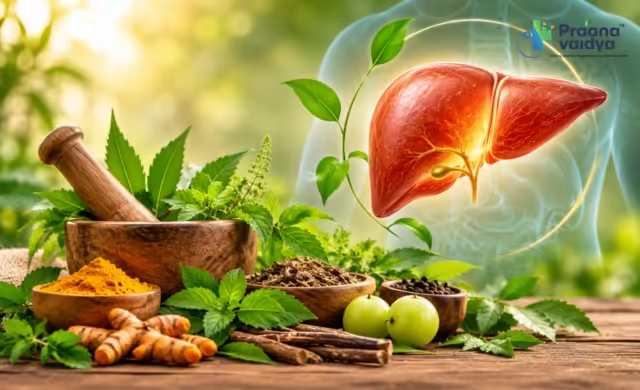

Ayurvedic principles form the foundation of one of India’s traditional systems of health and wellness. Rather than focusing only on individual symptoms, Ayurveda traditionally looks at the person as a whole and considers factors such as constitution, diet, digestion, lifestyle, environment, sleep, and daily routine.
The central idea is that health involves maintaining an appropriate balance between different physiological and functional aspects of the body and mind. When this balance is disturbed, Ayurveda uses concepts such as Dosha, Agni, Ama, Dhatus, Prakriti, and Vikriti to understand the individual’s condition.
Ayurveda also places considerable importance on prevention. Daily routines, seasonal adjustments, appropriate food habits, physical activity, rest, and mental well-being are traditionally considered part of maintaining health.
At Praanavaidya, consultation can help individuals understand these Ayurvedic concepts in relation to their own constitution, lifestyle, and current health concerns.
What Are Ayurvedic Principles?
Ayurvedic principles are the traditional concepts used to understand health, disease, diet, lifestyle, and individual differences.
Some of the major concepts include:
- Panchamahabhutas
- Tridosha
- Prakriti
- Vikriti
- Agni
- Ama
- Dhatus
- Malas
- Srotas
- Dinacharya
- Ritucharya
- Ojas
These concepts are interconnected rather than independent.
For example, Ayurveda traditionally considers how an individual’s Prakriti influences their natural tendencies, while Vikriti describes changes from that baseline. Doshas are then considered when understanding the current state.
1. Panchamahabhutas: The Five Elements
One of the foundational Ayurvedic principles is the concept of the five great elements, known as Panchamahabhutas.
They are:
- Akasha – space
- Vayu – air
- Agni – fire
- Jala – water
- Prithvi – earth
Ayurveda traditionally describes everything in nature, including the human body, through combinations of these elements.
The five elements provide the conceptual foundation for understanding the three Doshas.
2. Tridosha: Vata, Pitta and Kapha
The three Doshas are among the most widely recognised Ayurvedic concepts.
They are:
Vata
Associated traditionally with Akasha and Vayu.
Vata is linked with movement, communication, circulation, and various forms of activity.
Pitta
Associated traditionally with Agni and Jala.
Pitta is linked with transformation, digestion, metabolism, and heat.
Kapha
Associated traditionally with Jala and Prithvi.
Kapha is associated with stability, structure, lubrication, and support.
Every individual is understood to have all three Doshas, although their proportions and characteristics vary.
3. Prakriti: Your Individual Constitution
Prakriti refers to an individual’s natural constitution in Ayurveda.
It is traditionally understood to be established early in life and to influence characteristics such as:
- Body structure
- Appetite
- Digestion
- Energy patterns
- Skin tendencies
- Sleep
- Emotional tendencies
- Responses to environmental changes
Prakriti is one reason Ayurveda does not necessarily recommend the same diet or lifestyle routine to everyone.
For example, two people may eat the same food but experience it differently.
4. Vikriti: The Current State of Balance
While Prakriti represents an individual’s natural constitution, Vikriti is commonly used to describe the current state of imbalance or deviation from that baseline.
Ayurvedic assessment may therefore consider both:
Prakriti → What is naturally characteristic of the individual
Vikriti → What has changed or become imbalanced
Understanding this distinction is important when developing a personalised Ayurvedic approach.
5. Agni: The Concept of Digestive Fire
Agni is another central concept within Ayurveda.
The term is often translated as “digestive fire,” but its traditional meaning encompasses more than simply the digestion of food.
Ayurveda uses Agni to describe processes associated with transformation and metabolism.
A balanced Agni is traditionally associated with:
- Appropriate appetite
- Comfortable digestion
- Regular elimination
- Proper nourishment
Ayurvedic dietary practices therefore often consider not only what a person eats but also:
- When they eat
- How much they eat
- How well they digest food
- Whether the food is appropriate for their constitution
6. Ama: The Concept of Incompletely Processed Material
Ama is an Ayurvedic concept traditionally associated with improperly processed or incompletely digested material.
Ayurvedic texts describe Ama in relation to impaired digestive and metabolic processes.
Traditional signs attributed to Ama may include:
- Heaviness
- Coated tongue
- Reduced appetite
- Digestive discomfort
- Feeling sluggish
These symptoms are nonspecific from a modern medical perspective and can have many causes.
Therefore, Ayurvedic concepts such as Ama should be understood within their traditional framework rather than treated as modern medical diagnoses.
7. Dhatus: The Body’s Seven Tissues
Ayurveda traditionally describes seven Dhatus, or tissues.
They are:
- Rasa – fluid or nutritional tissue
- Rakta – blood
- Mamsa – muscle
- Meda – adipose tissue
- Asthi – bone
- Majja – marrow and nervous tissue
- Shukra/Artava – reproductive tissue
The Dhatu concept describes how nourishment is traditionally understood to move through different levels of bodily tissue.
It forms part of Ayurveda’s broader model of nutrition, development, and tissue maintenance.
8. Malas: The Body’s Waste Products
Ayurveda also recognises three primary Malas, or waste products:
- Purisha – stool
- Mutra – urine
- Sweda – sweat
Regular elimination is traditionally considered important for maintaining health.
This is why Ayurvedic lifestyle recommendations may pay attention to:
- Bowel regularity
- Urination
- Sweating
- Hydration
- Diet
- Physical activity
Persistent changes in bowel or urinary function should always be appropriately medically evaluated.
9. Srotas: Channels of the Body
Srotas refers to channels or pathways through which substances and processes are traditionally understood to move within the body.
Ayurvedic literature describes different Srotas associated with functions such as:
- Respiration
- Digestion
- Circulation
- Elimination
- Reproduction
The Srotas concept helps Ayurveda explain how disturbances may affect different parts of the body.
It is a traditional framework and should not be equated directly with a specific anatomical structure in modern medicine.
10. Ojas: Vitality and Resilience
Ojas is traditionally described as an important essence associated with vitality, strength, stability, and resilience.
Ayurvedic approaches to maintaining Ojas may emphasise:
- Adequate nourishment
- Sufficient sleep
- Emotional balance
- Appropriate exercise
- Healthy routines
- Avoiding excessive physical or mental strain
Rather than being viewed as a single measurable substance, Ojas is best understood as a traditional Ayurvedic concept.
11. Dinacharya: The Importance of Daily Routine
One of the practical principles of Ayurveda is Dinacharya, or daily routine.
Ayurveda traditionally recognises regularity as an important part of maintaining health.
A daily routine may include:
- Waking at an appropriate time
- Oral hygiene
- Personal cleansing
- Physical activity
- Yoga
- Meditation
- Regular meals
- Appropriate work and rest
- Consistent sleep
The exact routine should be practical and adapted to the individual’s circumstances.
12. Ritucharya: Adapting to the Seasons
Ayurveda also recognises the influence of seasonal changes through the concept of Ritucharya.
Diet and lifestyle may be adjusted according to changes in:
- Temperature
- Humidity
- Activity
- Appetite
- Environment
For example, a routine that feels comfortable during winter may need modification during a hot summer.
Seasonal eating and lifestyle adjustments are intended to help individuals adapt to their surroundings.
13. Food as Part of Ayurvedic Health
Food is an important component of Ayurvedic lifestyle.
Traditional Ayurvedic dietary principles consider:
- Taste
- Qualities of food
- Digestive capacity
- Quantity
- Timing
- Preparation
- Individual constitution
- Season
Ayurveda does not necessarily classify a food as universally “good” or “bad.”
The same food can be appropriate for one person and less suitable for another depending on circumstances.
A balanced modern diet should still provide adequate calories, protein, vitamins, minerals, fibre, and other essential nutrients.
14. The Importance of Balance
Balance is a recurring theme across many Ayurvedic principles.
Ayurveda traditionally considers health in terms of relationships between:
- Doshas
- Agni
- Dhatus
- Malas
- Mind
- Senses
- Lifestyle
- Environment
The objective is not necessarily to eliminate one Dosha.
All three Doshas are considered part of normal physiology within the Ayurvedic framework.
The focus is on maintaining an appropriate state for the individual.
15. Prevention in Ayurveda
Ayurveda traditionally gives considerable importance to prevention.
Preventive practices may include:
- Regular sleep
- Balanced nutrition
- Physical activity
- Personal hygiene
- Stress management
- Seasonal adjustments
- Appropriate daily routine
- Avoiding excessive habits
This preventive orientation makes Ayurveda relevant not only when a person is unwell but also when they are trying to establish sustainable lifestyle habits.
Conclusion
Ayurvedic principles provide the traditional framework through which Ayurveda understands health, lifestyle, nutrition, and individual differences. Concepts such as Panchamahabhutas, Doshas, Prakriti, Vikriti, Agni, Dhatus, Malas, Srotas, Ojas, Dinacharya, and Ritucharya are interconnected within this system.
One of Ayurveda’s defining ideas is individualisation. Rather than assuming that one diet, routine, or therapy suits everyone, Ayurveda traditionally considers constitution, current condition, digestion, lifestyle, environment, and season.
Many of these principles can be translated into practical habits such as maintaining regular meals, getting sufficient sleep, staying physically active, managing stress, and adapting routines to seasonal changes.
At Praanavaidya, consultation can help you understand these traditional Ayurvedic concepts and explore how appropriate lifestyle and wellness practices may fit your individual needs.
Ayurveda can be part of a broader approach to well-being, but persistent or serious health concerns should receive appropriate medical evaluation and care.
Visit Us in-
Rajajinagar- 08065903133
Hubballi – 08065903145
Indiranagar- 08065903135
Mumbai-08065903118
Yelahanka- 08065903134
Mangaluru-08065903136
Chamrajpet-08065903132
Delhi-08065903140
Lucknow-08065903130
Frequently Asked Questions
What are the main Ayurvedic principles?
The main Ayurvedic principles include Panchamahabhutas, Tridosha, Prakriti, Vikriti, Agni, Ama, Dhatus, Malas, Srotas, Ojas, Dinacharya, and Ritucharya.
What are the three Doshas in Ayurveda?
The three Doshas are Vata, Pitta, and Kapha. Ayurveda traditionally describes them as functional principles associated with different combinations of the five elements.
What is Prakriti in Ayurveda?
Prakriti refers to an individual’s natural constitution according to Ayurvedic tradition. It is used to understand individual tendencies and differences.
What is Vikriti in Ayurveda?
Vikriti is commonly used to describe the current state of imbalance or deviation from an individual’s natural constitution.
What is Agni in Ayurveda?
Agni is a traditional Ayurvedic concept related to digestion, transformation, and metabolism..
Are Ayurvedic principles suitable for everyone?
The principles can provide a traditional framework for lifestyle and wellness, but individual recommendations should consider age, health status, medications, pregnancy, and other factors.
Praanavaidya
Healthcare Professional
Focused on patient-centric care and evidence-based treatment plans.
More from Praanavaidya