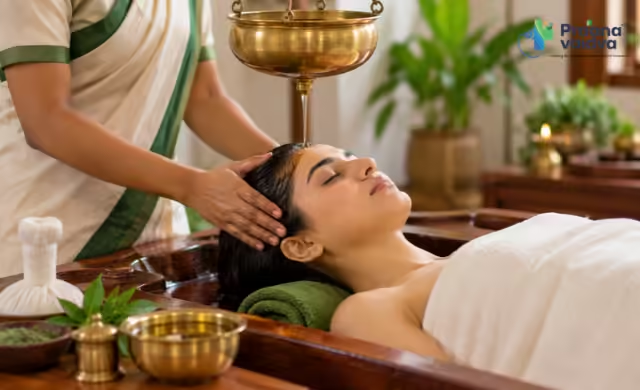

When people explore traditional and complementary healthcare options, Ayurveda vs Homeopathy is a common comparison. Both systems have long histories and use individualised approaches, but their underlying philosophies, treatment principles, medicines, and methods of assessment are different.
Ayurveda is an ancient Indian system of health that traditionally looks at the relationship between the Doshas, digestion, lifestyle, diet, tissues, and overall wellbeing. Homeopathy is a distinct system based on the principle of “like cures like” and uses highly diluted preparations selected according to an individual’s symptom profile.
Understanding these differences can help people make informed decisions rather than assuming that the two systems are simply different versions of the same approach.
At Praanavaidya, Ayurvedic consultation focuses on understanding the individual’s constitution, current health concerns, lifestyle, diet, and other relevant factors before developing an appropriate Ayurvedic care plan.
What Is Ayurveda?
Ayurveda is a traditional Indian system of medicine with a holistic approach to health and wellbeing.
The word Ayurveda is commonly translated as the “knowledge of life.”
Its traditional framework considers several interconnected aspects of health, including:
- Prakriti
- Vikriti
- Vata, Pitta and Kapha
- Agni or digestive/metabolic function
- Dhatus or tissues
- Malas or waste products
- Ojas
- Diet
- Lifestyle
- Sleep
- Mental wellbeing
Ayurvedic care can include dietary recommendations, lifestyle practices, herbal preparations, yoga, massage, and specialised traditional therapies.
The approach is generally personalised rather than based only on the name of a disease.
What Is Homeopathy?
Homeopathy is a system of complementary medicine that originated in Europe in the late 18th century.
Its traditional approach is based primarily on the principle that a substance capable of producing certain symptoms in a healthy person may, when prepared according to homeopathic methods, be used to address similar symptoms in a person who is unwell.
Homeopathic remedies are typically prepared through repeated dilution and shaking, a process known as potentisation.
Homeopathic practitioners may select remedies based on a detailed assessment of an individual’s symptoms and characteristics.
Homeopathy and Ayurveda therefore have different theoretical foundations even though both may involve individualised consultations.
Ayurveda vs Homeopathy: The Fundamental Difference
The most important distinction is their underlying healthcare philosophies.
Ayurveda
Ayurveda traditionally understands health through concepts such as:
- Dosha balance
- Prakriti
- Vikriti
- Agni
- Dhatus
- Ojas
- Diet and lifestyle
Homeopathy
Homeopathy traditionally centres on:
- The principle of similars
- Individual symptom patterns
- Individual remedy selection
- Highly diluted preparations
Therefore, the two systems should not be treated as interchangeable.
Ayurveda vs Homeopathy: A Simple Comparison
| Aspect | Ayurveda | Homeopathy |
| Origin | India | Europe |
| Traditional foundation | Ayurvedic principles of health and balance | Principle of similars |
| Individual assessment | Prakriti, Vikriti, Doshas, lifestyle and symptoms | Individual symptom profile |
| Medicines | Herbal and other traditional preparations | Homeopathic preparations |
| Diet | Often an important part of care | Usually not based on Ayurvedic dietary principles |
| Lifestyle | Strong emphasis | May be considered depending on practitioner |
| External therapies | Several traditional therapies | Generally not a central component |
| Panchakarma | Part of specialised Ayurvedic practice | Not a homeopathic therapy |
| Doshas | Central Ayurvedic concept | Not part of homeopathic theory |
| Treatment philosophy | Holistic Ayurvedic framework | Homeopathic framework based on similars |
How Does an Ayurvedic Consultation Work?
An Ayurvedic consultation may involve a detailed discussion of:
- Main health concerns
- Digestion
- Appetite
- Sleep
- Daily routine
- Diet
- Physical activity
- Stress
- Medical history
- Prakriti
- Vikriti
- Lifestyle patterns
Traditional Ayurvedic assessment may also involve examination methods described within Ayurveda.
The objective is to understand the person’s overall health pattern and identify an appropriate Ayurvedic approach.
How Does a Homeopathic Consultation Differ?
A homeopathic consultation generally focuses heavily on the individual’s symptoms and their characteristics.
A practitioner may ask about:
- Location of symptoms
- Sensations
- Factors that worsen or improve symptoms
- Timing
- Associated symptoms
- Emotional characteristics
- General health patterns
The information is then used within homeopathic principles to select a remedy.
While both systems can involve detailed consultations, the frameworks used to interpret the information are different.
Ayurveda Places Greater Emphasis on Diet and Lifestyle
One notable feature of Ayurveda is its emphasis on everyday habits.
An Ayurvedic plan may include recommendations related to:
- Meal timing
- Food choices
- Sleep routine
- Exercise
- Daily routine
- Stress management
- Seasonal routines
- Personal habits
These recommendations are often individualised according to Ayurvedic principles.
The objective is not simply to address symptoms but to encourage habits that support overall wellbeing.
The Role of Ayurvedic Herbs
Ayurveda has a long tradition of using medicinal plants and herbal preparations.
Examples of commonly discussed Ayurvedic herbs include:
- Ashwagandha
- Turmeric
- Guduchi
- Triphala
- Brahmi
- Shatavari
- Ginger
- Amla
However, “natural” does not automatically mean “safe for everyone.”
Herbal products can have pharmacological effects and may interact with prescription medicines or be unsuitable for certain medical conditions.
Therefore, herbs should be selected according to individual needs and used appropriately.
What Makes Homeopathic Remedies Different?
Homeopathic remedies are prepared according to specific homeopathic dilution and potentisation procedures.
Many preparations are diluted to very high levels.
The underlying explanation for how homeopathy is supposed to work differs from conventional pharmacology and from Ayurvedic herbal medicine.
Therefore, an Ayurvedic herbal preparation and a homeopathic remedy should not be considered equivalent simply because both may be described as complementary or traditional forms of healthcare.
Ayurveda Includes External Therapies
Another major distinction in Ayurveda vs Homeopathy is the role of external therapies.
Depending on the individual’s condition, Ayurvedic practice may include therapies such as:
- Abhyanga
- Swedana
- Shirodhara
- Kati Basti
- Prishthabasti
- Pizhichil
- Basti
- Nasya
- Other specialised procedures
These therapies are selected according to the individual’s condition and the practitioner’s assessment.
Homeopathy does not have an equivalent system of Ayurvedic external therapies.
Ayurveda vs Homeopathy: Which One Is Better?
There is no universal answer to which system is “better.”
The two systems are based on different principles and approaches.
The more useful question is:
Which healthcare approach is appropriate for the individual’s specific health concern, medical needs, preferences, and safety requirements?
For certain symptoms, conventional medical diagnosis and treatment may be essential.
For people interested in Ayurvedic care, an appropriate Ayurvedic consultation can help determine whether traditional Ayurvedic practices can be used as supportive care.
Final Thoughts
Understanding Ayurveda vs Homeopathy requires looking beyond the fact that both are often described as complementary systems.
Ayurveda is a traditional Indian health system built around concepts such as Doshas, Prakriti, Vikriti, Agni, diet, lifestyle, herbs, and specialised therapies. Homeopathy is a distinct system based on the principle of similars and specially prepared remedies.
Their consultation methods and treatment philosophies therefore differ substantially.
If you are considering Ayurvedic care, the most useful starting point is not simply choosing a remedy based on a symptom. A personalised Ayurvedic assessment can help determine which traditional approaches may be appropriate for your individual situation.
At Praanavaidya, Ayurvedic consultation focuses on understanding the individual’s constitution, current health patterns, lifestyle, and other relevant factors before discussing an appropriate traditional care plan.
Most importantly, complementary healthcare should work alongside responsible medical care when diagnosis or conventional treatment is necessary.
Visit Us in-
Rajajinagar- 08065903133
Hubballi – 08065903145
Indiranagar- 08065903135
Mumbai-08065903118
Yelahanka- 08065903134
Mangaluru-08065903136
Chamrajpet-08065903132
Delhi-08065903140
Lucknow-08065903130
Frequently Asked Questions About Ayurveda vs Homeopathy
Is Ayurveda the same as homeopathy?
No. Ayurveda and homeopathy are distinct systems with different origins, theories, assessment methods, and treatment approaches.
What is the main difference between Ayurveda and homeopathy?
Ayurveda traditionally uses concepts such as Doshas, Prakriti, Vikriti, Agni, diet, lifestyle, herbs, and therapies. Homeopathy is based on the principle of similars and uses specially prepared highly diluted remedies.
Is Ayurveda better than homeopathy?
Neither can be described as universally better. They are based on different principles. The appropriate healthcare approach depends on the individual’s condition and medical needs.
Does Ayurveda use herbs?
Yes. Herbal preparations are an important part of many Ayurvedic treatment approaches, although not every Ayurvedic treatment involves herbs.
Does homeopathy use herbs?
Some homeopathic remedies may originate from plants, but they are prepared according to homeopathic procedures and should not be confused with Ayurvedic herbal medicines.
Can Ayurveda and homeopathy be taken together?
Combining treatments should be discussed with qualified healthcare professionals, particularly when herbal preparations or conventional medicines are also being used.
Is Ayurveda suitable for everyone?
Not every Ayurvedic treatment is appropriate for every person. Individual assessment is important, particularly for people with existing medical conditions or those taking medication.
Praanavaidya
Healthcare Professional
Focused on patient-centric care and evidence-based treatment plans.
More from Praanavaidya