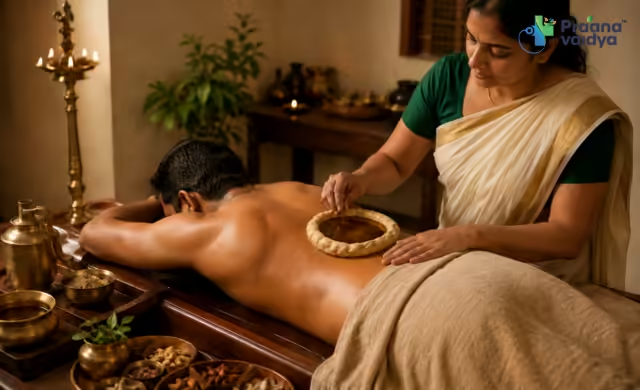
Back discomfort, stiffness, muscle tightness, and restricted movement are common concerns that can affect work, exercise, sleep, and everyday activities. Ayurveda offers several traditional external therapies that are used to support musculoskeletal care. Prishthabasti is one such local oil-retention therapy traditionally applied over the back.
Unlike a simple oil massage, Prishthabasti involves creating a contained area over the selected region of the back and retaining warm medicated oil within it for a prescribed period. The choice of oil, temperature, duration, and treatment area may vary according to the individual’s Ayurvedic assessment.
The therapy is traditionally used as part of supportive care for selected back and musculoskeletal complaints.
At Praanavaidya, consultation can help determine whether Prishthabasti is appropriate for an individual’s symptoms and how it may fit into a broader Ayurvedic care plan.
What Is Prishthabasti?
Prishthabasti is a traditional Ayurvedic external therapy in which warm oil is retained over a selected area of the back using a dough-like boundary.
The word can broadly be understood as:
- Prishtha – back
- Basti – a method of retaining or holding
Despite the word “Basti,” Prishthabasti is a local external therapy and should not be confused with the internal Basti therapy used in Panchakarma.
The treatment allows warm oil to remain in contact with a targeted area for a specific period.
How Is Prishthabasti Different From Regular Abhyanga?
Both therapies may involve Ayurvedic oils, but their application is different.
Abhyanga
Abhyanga is a traditional Ayurvedic oil massage involving application and massage of oil over the body or selected areas.
Prishthabasti
Prishthabasti involves:
- Creating a dough boundary
- Positioning it over the selected back region
- Filling the enclosed area with warm oil
- Retaining the oil for a prescribed duration
- Replacing the oil when necessary to maintain appropriate warmth
The focus is therefore on localised oil retention rather than massage alone.
What Happens During a Prishthabasti?
The exact procedure can vary according to the practitioner and treatment plan.
A typical session may involve the following steps.
1. Ayurvedic Assessment
The practitioner evaluates the person’s symptoms and overall condition.
Factors such as pain, stiffness, duration of symptoms, mobility, Prakriti, Vikriti, and other health concerns may be considered.
2. Selection of the Oil
An appropriate Ayurvedic oil may be selected according to the treatment objective and individual assessment.
The oil used is not necessarily the same for every person.
3. Preparation of the Treatment Area
The patient is positioned comfortably, generally in a way that allows the back to remain accessible.
4. Creating the Boundary
A ring or wall made from suitable dough is carefully placed over the selected region of the back.
This creates a small reservoir for retaining the oil.
5. Adding Warm Oil
Warm medicated oil is gently poured into the enclosed area.
The temperature should be comfortable and carefully monitored.
6. Oil Retention
The oil remains within the boundary for a prescribed period.
If the oil cools significantly, it may be replaced with appropriately warm oil according to the treatment protocol.
7. Removal and Cleaning
Once the session is complete, the oil is removed and the area is gently cleaned.
The patient may then receive specific post-treatment advice.
Why Is Warm Oil Used?
Warmth is an important part of many traditional Ayurvedic external therapies.
In the Ayurvedic framework, warm oil applications are traditionally associated with qualities that may be useful when coldness, dryness, or stiffness are prominent.
From a practical perspective, warmth may feel soothing and relaxing around tense muscles.
However, the oil should never be excessively hot.
Temperature should be carefully monitored to prevent burns or skin injury.
Traditional Ayurvedic Uses of Prishthabasti
Prishthabasti may traditionally be considered as supportive care for selected conditions involving the back.
These may include presentations associated with:
- Back stiffness
- Muscular tightness
- Local discomfort
- Restricted movement
- Dryness or Vata-related musculoskeletal complaints
The therapy should not be viewed as a universal treatment for every type of back pain.
The underlying cause matters.
Prishthabasti for Back Stiffness
Stiffness can make activities such as bending, sitting, standing, or exercising uncomfortable.
A warm oil-retention treatment may provide a soothing sensation over the treated area.
Within Ayurveda, practitioners may consider Prishthabasti when stiffness is associated with qualities traditionally attributed to Vata, such as dryness, coldness, or restricted movement.
Appropriate movement and strengthening may still be necessary depending on the underlying problem.
Prishthabasti and Lower Back Discomfort
Lower back discomfort can result from many different causes, including:
- Muscle strain
- Poor movement patterns
- Prolonged sitting
- Disc-related problems
- Arthritis
- Nerve irritation
- Injuries
Prishthabasti may be considered as a complementary traditional therapy in selected cases.
It should not be assumed to correct structural problems such as a significant disc herniation or spinal fracture.
A proper assessment is important before beginning treatment.
Prishthabasti and the Ayurvedic Concept of Vata
Vata is traditionally associated with:
- Movement
- Dryness
- Lightness
- Coldness
- Irregularity
Many musculoskeletal complaints are traditionally discussed in relation to Vata.
Warm oil therapies are therefore commonly considered within Ayurvedic approaches when Vata-related qualities are prominent.
However, an Ayurvedic treatment decision is not based on Dosha alone. The individual’s current symptoms, age, season, strength, health status, and other factors are also considered.
What Are the Traditional Benefits of Prishthabasti?
Ayurvedic practitioners may use Prishthabasti to support:
Local Comfort
Warm oil retention may create a soothing sensation over the back.
Muscle Relaxation
The warmth may help the treated area feel more relaxed.
Support for Stiffness
The therapy is traditionally used when stiffness and restricted movement are prominent.
Nourishing Oil Application
Ayurvedic oils are traditionally considered beneficial for selected Vata-related musculoskeletal presentations.
Relaxation
A warm oil treatment can be a calming experience for some people.
These are traditional and supportive uses, not guarantees that the therapy will treat or cure an underlying disease.
Prishthabasti vs Kati Basti
These two therapies are often confused.
| Prishthabasti | Kati Basti |
| Applied over a selected area of the back | Usually focused on the lower back region |
| May cover a broader back area | More localised around the Kati/lower-back region |
| Uses warm medicated oil | Uses warm medicated oil |
| Oil is retained within a dough boundary | Oil is retained within a dough boundary |
| Used according to individual assessment | Used according to individual assessment |
Terminology and treatment methods can vary between Ayurvedic traditions and practitioners.
Therefore, patients should ask the practitioner exactly which region will be treated.
How Long Does a Prishthabasti Session Take?
There is no single standard duration for every person.
Treatment time may depend on:
- Selected oil
- Treatment area
- Individual condition
- Treatment objective
- Practitioner protocol
- Patient tolerance
The oil-retention period should be determined by the practitioner rather than assuming that a longer session is always better.
Final Takeaway
Prishthabasti is a traditional Ayurvedic external oil-retention therapy designed to provide localised warm oil application over a selected region of the back. It differs from ordinary oil massage because the oil is retained within a specially created boundary for a prescribed period.
Ayurveda traditionally uses this type of therapy for selected presentations involving back stiffness, local discomfort, muscular tightness, and restricted movement, particularly when Vata-related qualities are considered prominent.
However, back pain can arise from many different causes, and not every spinal or musculoskeletal condition is suitable for warming therapies. Appropriate assessment is therefore essential.
At Praanavaidya, consultation can help determine whether Prishthabasti is suitable for your specific concern and how it may fit into a broader Ayurvedic care plan.
Prishthabasti is best understood as a supportive traditional therapy, not a universal cure or replacement for necessary medical or physiotherapy care.
Visit Us in-
Rajajinagar- 08065903133
Hubballi – 08065903145
Indiranagar- 08065903135
Mumbai-08065903118
Yelahanka- 08065903134
Mangaluru-08065903136
Chamrajpet-08065903132
Delhi-08065903140
Lucknow-08065903130
Frequently Asked Questions
What is Prishthabasti?
Prishthabasti is a traditional Ayurvedic external therapy in which warm medicated oil is retained over a selected region of the back using a dough-like boundary.
Is Prishthabasti a whole-spine treatment?
It can involve a broader area of the back depending on the treatment plan, but the exact area is determined according to the individual’s condition. It should not automatically be assumed to cover the entire spine.
Is Prishthabasti the same as Kati Basti?
No. Kati Basti is generally more focused on the lower-back region, while Prishthabasti may involve a broader selected area of the back. Terminology can vary between practitioners.
What oil is used for Prishthabasti?
The oil depends on the individual’s condition and Ayurvedic assessment. There is no single oil that is appropriate for everyone.
Can Prishthabasti help with back stiffness?
It is traditionally used as supportive care for selected presentations involving stiffness and local discomfort. Its suitability depends on the underlying cause.
How long does Prishthabasti take?
The duration varies according to the treatment protocol, oil, treatment area, and individual needs.
Can Prishthabasti cure spinal problems?
It should not be described as a guaranteed cure for structural spinal disorders. It may be used as a complementary traditional therapy for selected symptoms.
Praanavaidya
Healthcare Professional
Focused on patient-centric care and evidence-based treatment plans.
More from Praanavaidya