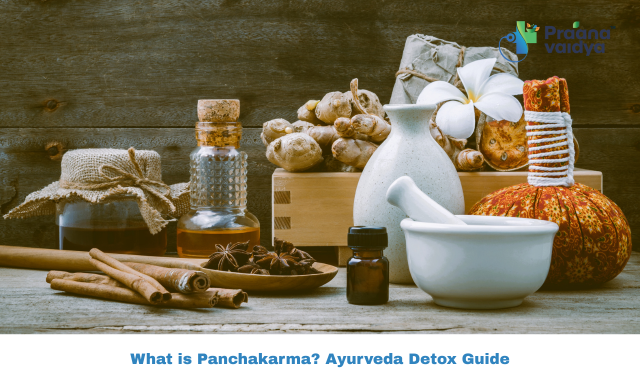
Panchakarma is ayurveda’s most complete detoxification and healing system. The word means ‘five actions’ — referring to five therapeutic procedures that eliminate accumulated toxins (Ama) from the body, restore balance between the three doshas (Vata, Pitta, Kapha), and create the conditions for genuine healing.
Book your consultation | Call us: +91 08065903127
What is panchakarma — the full explanation
Panchakarma comes from two Sanskrit words: pancha (five) and karma (action or treatment). It is a system of five therapeutic procedures described in the ancient ayurvedic texts — the Charaka Samhita and the Sushruta Samhita — written over 2,000 years ago.
Panchakarma is not just about the five procedures. It is a complete three-phase process:
1. Purva Karma — preparation: softening and mobilising toxins before the main treatment
2. Pradhana Karma — the main five therapies: eliminating toxins through specific pathways
3. Paschat Karma — recovery: rebuilding digestive strength and sustaining the results
What makes panchakarma different from a spa detox is that it works at the tissue level — not just the digestive tract. Through medicated oils, herbal preparations, steam therapies, and precise elimination procedures, panchakarma reaches the deep tissues (Dhatus) where chronic disease originates and removes toxins that dietary changes alone cannot touch.
Why the body needs this kind of deep cleanse
Modern life creates a constant accumulation of what ayurveda calls Ama — unprocessed waste at the cellular level. Poor digestion, stress, erratic sleep, processed food, environmental pollutants, and suppressed emotions all contribute to Ama build-up. Over years, this Ama settles in joints (arthritis), channels (cardiovascular issues), hormonal pathways (PCOD, thyroid), and skin (eczema, psoriasis).
Regular medicine addresses the downstream effect — the symptom. Panchakarma addresses the upstream cause — the accumulated waste that created it.
The five therapies — what each one does
Here are the five Karmas of Panchakarma, explained in plain language:
| # | Karma | What it does | Best for |
| 1 | Vamana | Therapeutic emesis — expels Kapha toxins through the upper GI tract | Asthma, sinusitis, skin diseases, obesity |
| 2 | Virechana | Controlled purgation — flushes Pitta and Ama through the intestines | Arthritis, liver disorders, skin conditions, acid reflux |
| 3 | Basti | Medicated enema — the most powerful Vata treatment; cleanses and nourishes | Joint pain, neurological issues, constipation, infertility |
| 4 | Nasya | Nasal administration of medicated oils — clears head and neck channels | Migraines, sinusitis, hair loss, cervical spondylitis |
| 5 | Raktamokshana | Bloodletting — removes vitiated blood (used selectively) | Skin diseases, gout, varicose veins, chronic infections |
The three phases of a panchakarma course
The three phases explains why panchakarma requires proper medical supervision — and why doing it at a qualified centre matters far more than a wellness retreat that offers ‘panchakarma’ as a luxury package.
| Phase | What happens |
| Days 1–3 Purva Karma (Preparation) | Oleation (Snehana) — internal and external application of medicated ghee or oils to loosen toxins from tissues. Your digestive system is assessed and herbal preparations begin. |
| Days 4–7 Pradhana Karma (Main treatment) | The primary therapies begin — Abhyanga massage, Swedana steam, and the specific Panchakarma procedure(s) prescribed for your condition. This is where the deep detoxification occurs. |
| Days 8–10 Paschata Karma (Recovery) | Gentle diet (Samsarjana Krama), herbal rasayanas, and lifestyle guidance. The digestive fire is rebuilt gradually. This phase is as important as the treatment itself — skipping it undermines the results. |
Supporting therapies used alongside panchakarma
The five Karmas are the core of panchakarma, but they are almost always administered alongside a set of preparatory and supportive therapies. Here are the most commonly used at Praanavaidya:
Abhyanga — full body oil massage
Warm medicated oil is applied by two therapists in synchronised rhythmic strokes across the entire body for 45 to 60 minutes. Abhyanga is the foundational preparation for almost every panchakarma treatment — it loosens Ama from the tissues, nourishes the nervous system, and prepares the body to release toxins through the Swedana that follows.
The oil used depends on your dosha — Dhanwantaram taila for Vata, Ksheerabala for neurological conditions, Nalpamaradi for skin diseases. This is not an aromatherapy massage. The selection, temperature, and strokes are all prescribed precisely.
Swedana — herbalised steam therapy
After Abhyanga, the body is placed in a steam chamber infused with specific herbs. The heat dilates blood vessels, opens the channels (Srotas), and causes the Ama loosened during massage to move into the digestive tract — where the main Karma therapies will eliminate it. Without Swedana, the toxins mobilised by Abhyanga have nowhere to go.
Shirodhara — the oil stream therapy
A thin, continuous stream of warm medicated oil is poured onto the forehead (the seat of the nervous system) from a copper vessel for 30 to 45 minutes. Shirodhara induces a state of deep neurological calm — reducing cortisol, calming Vata in the nervous system, and producing effects on anxiety, insomnia, and stress that patients frequently describe as unlike anything they have experienced before.
It is one of the most requested treatments at Praanavaidya, and one of the most misrepresented outside qualified centres. The oil selection (Brahmi taila, Ksheerabala, plain sesame) determines its therapeutic effect — it is not interchangeable.
Patra Pinda Sweda — herbal leaf bolus
Bundles of specific medicinal leaves — typically Eranda, Nirgundi, and Castor — are heated in medicated oil and applied rhythmically to the body. This is the primary therapy for joint and musculoskeletal conditions at Praanavaidya. The combination of heat, oil, and the specific alkaloids in the leaves reduces inflammation, relieves stiffness, and improves circulation to damaged joint tissue.
Kati Basti and Janu Basti — localised oil pools
A ring of dough is built around the lower back (Kati) or knee (Janu), filled with warm medicated oil, and maintained for 30 to 45 minutes. The oil penetrates deep into the joint capsule or spinal disc, lubricating tissue and reducing both pain and structural inflammation. Most of our arthritis and sciatica patients consider Basti therapies the turning point in their recovery.
Which conditions does panchakarma treat?
Panchakarma is not a single-condition treatment. Because it addresses systemic toxin accumulation and dosha imbalance — the root cause of most chronic disease — it has documented benefit across a wide range of conditions:
| Joint & musculoskeletal | Hormonal & metabolic | Skin & neurological |
| Arthritis (RA & OA) Sciatica Back pain Cervical spondylitis Frozen shoulder | PCOD Thyroid disorders Fatty liver Obesity Diabetes (Type 2 support) | Eczema Psoriasis Migraine Anxiety & burnout Parkinson’s support |
Panchakarma is also used as preventive treatment (Swasthavritta) — an annual or biannual deep cleanse for people who are otherwise healthy but want to maintain optimal function, prevent lifestyle disease, and slow biological ageing.
Ready to experience panchakarma at Praanavaidya?
Visit Praanavaidya – Our Branches:
Rajajinagar- 08065903133
Hubballi – 08065903145
Indiranagar- 08065903135
Mumbai-08065903118
Yelahanka- 08065903134
Mangaluru-08065903136
Chamrajpet-08065903132
Frequently asked questions about panchakarma
How long does a panchakarma course take?
A standard course is 7, 14, or 21 days depending on the condition being treated. Preventive panchakarma for a healthy individual can be completed in 7 days. Chronic conditions like rheumatoid arthritis, PCOD, or fatty liver typically require 14 to 21 days for meaningful improvement.
Is panchakarma painful?
No. The therapies are therapeutic — never painful. Some patients experience mild discomfort during the elimination phases (Virechana or Basti) or emotional releases during Shirodhara. These are expected and managed by your doctor. The overall experience is deeply restful for most people.
What is the cost of panchakarma at Praanavaidya?
Treatment costs depend on the duration of the programme, the therapies prescribed, and whether you are an outpatient or a residential patient. Contact us directly for a personalised quote. We believe in complete cost transparency before treatment begins — no hidden charges.
Can I do panchakarma if I am on modern medication?
In most cases, yes. Our doctors work with your existing medical care, not against it. We will review your current medications and, where the condition improves sufficiently, work with you and your physician to reduce dosages gradually. We never advise stopping prescribed medication without medical supervision.
How often should I do panchakarma?
Classical ayurvedic texts recommend one full Panchakarma course per season — four times a year — for optimal health. For most modern patients, one annual or biannual course is realistic and highly beneficial. Your doctor will recommend an appropriate frequency based on your condition and response to the first course.
What is the difference between panchakarma and a regular ayurvedic massage?
A panchakarma course is a complete medical treatment programme — prescribed, monitored, and adjusted by a qualified BAMS physician. An ayurvedic massage is a single therapy. Abhyanga massage is part of panchakarma, but the full system includes internal preparation, elimination therapies, post-treatment recovery, and herbal medicine. The two are not interchangeable.
Praanavaidya
Healthcare Professional
Focused on patient-centric care and evidence-based treatment plans.
More from Praanavaidya