
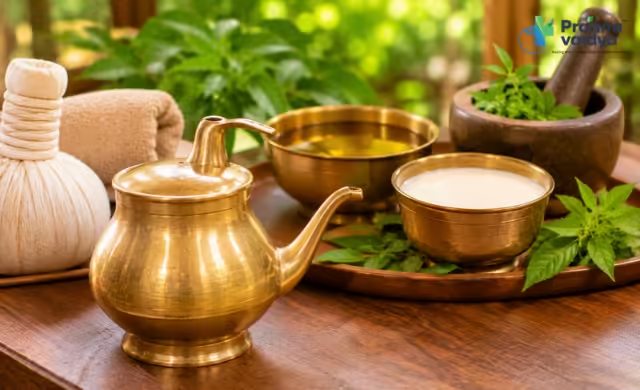
Basti in Ayurveda is not a single, standardised procedure. The term covers different approaches that vary by the substance used, quantity, route, timing and the way the procedure is planned. That is why searching for the “best Basti” can be misleading.
This guide explains the main types of Basti in Ayurveda in simple terms, how they differ, and why the choice should be made after an individual Ayurveda consultation rather than from symptoms or an online list alone.
What Is Basti in Ayurveda?
Basti is a traditional Ayurvedic procedure associated with Panchakarma. In simple terms, it involves administering a prepared substance through a prescribed route, with the preparation and schedule selected according to the practitioner’s assessment.
The word “Basti” is often used broadly, which can make online information confusing. Different Basti types may vary in:
- The material or preparation used
- The quantity administered
- The route of administration
- The timing and frequency
- Whether the approach is used as part of a particular Panchakarma schedule
Because of these differences, two people asking for “Basti treatment” may not necessarily be referring to the same procedure.
Main Types of Basti in Ayurveda
The most commonly discussed categories include Niruha Basti, Anuvasana Basti, Matra Basti and Uttara Basti. Some Ayurvedic classifications also describe Basti according to the number and sequence of procedures, such as Karma Basti, Kala Basti and Yoga Basti.
Niruha Basti
Niruha Basti is also known as Asthapana Basti or Kashaya Basti in different contexts. It is generally described as a Basti preparation in which a herbal decoction forms an important part of the formulation, along with other ingredients selected according to the practitioner’s approach.
The preparation is not a fixed recipe for everyone. The ingredients, quantity, timing and overall plan can vary.
For a reader comparing Basti types, the important point is that Niruha Basti is a distinct category from oil-based Basti approaches.
Anuvasana Basti
Anuvasana Basti is traditionally described as an oil-based Basti approach. The preparation, quantity and timing are selected according to the individual plan.
It is important not to assume that every oil-based Basti is interchangeable. The oil or other prescribed substance, quantity and schedule can differ.
Matra Basti
Matra Basti is generally described as a smaller-quantity form of oil-based Basti. The word “Matra” relates to the measured quantity used.
Because quantity and timing are part of the procedure, Matra Basti should not be selected simply because it sounds like a smaller or simpler option. A practitioner should determine whether it is appropriate for the individual situation.
Uttara Basti
Uttara Basti is a specialised form of Basti that uses a different local route from the commonly discussed rectal administration of other Basti procedures. It requires specific clinical knowledge and should only be considered after appropriate assessment.
Because this procedure involves a specialised route, it should never be attempted without professional supervision.
Basti Schedules: Karma, Kala and Yoga Basti
You may also come across terms such as Karma Basti, Kala Basti and Yoga Basti while researching Panchakarma.
These terms are better understood as planned Basti schedules or combinations rather than completely different substances. The number, order and timing of procedures can differ.
This distinction matters because “types of Basti” can refer to two different things: the nature of the preparation itself or the schedule in which Basti is organised.
How Are Basti Types Different?
A simple way to understand the main categories is to compare them by their defining feature:
- Niruha/Asthapana Basti: commonly described around a decoction-based preparation.
- Anuvasana Basti: commonly described as an oil-based preparation.
- Matra Basti: a smaller-quantity oil-based approach.
- Uttara Basti: a specialised Basti approach using a different local route.
- Karma, Kala and Yoga Basti: schedule-based classifications describing how Basti procedures may be organised.
The exact preparation, quantity, timing and sequence are not universal. They are part of the practitioner’s individual plan.
Which Basti Is Right for You?
There is no reliable way to choose a Basti type from a symptom, social media post or keyword search alone.
An Ayurveda practitioner may consider several factors during an assessment, such as:
- Your health history
- Current symptoms and concerns
- Age and general health status
- Digestion and bowel patterns
- Current medicines and supplements
- Existing health conditions
- Pregnancy status, where relevant
- Recent procedures or surgery
- Previous experience with Panchakarma
- The intended purpose and overall plan of care
The goal of the consultation is not simply to match a symptom with a Basti name. It is to understand whether Basti is appropriate to discuss at all and, if so, which form and schedule may fit the individual plan.
This is why two people with similar concerns may receive different recommendations.
How Is a Basti Plan Usually Decided?
A consultation-led approach can be understood in four simple stages.
1. Assessment
The practitioner reviews your health history, current concerns, medicines and relevant personal factors.
2. Selection
If Basti is considered appropriate, the practitioner identifies the type, preparation and schedule to be discussed.
3. Planning
The timing, quantity, preparation and any associated Panchakarma steps are planned according to the individual situation.
4. Follow-up
The practitioner reviews how the plan is progressing and decides whether any adjustment or reassessment is needed.
If you want to explore Basti therapy, speak with a qualified Ayurveda practitioner rather than choosing a type based only on online descriptions.
Basti and Panchakarma: Are They the Same?
No. Basti is one of the procedures discussed within the broader Ayurvedic framework of Panchakarma.
Panchakarma is traditionally described as a group of procedures, while Basti refers to a particular category within that framework. This is why you may see terms such as “Panchakarma Basti” and “Basti therapy” used together.
Understanding this difference can make it easier to read treatment pages and discuss your options during an Ayurveda consultation.
What Should You Ask Before Choosing Basti?
A consultation is also an opportunity to ask practical questions. Consider asking:
- Which type of Basti is being considered?
- What preparation will be used?
- How is the quantity decided?
- How many sessions are being proposed?
- What preparation is required beforehand?
- Are any current medicines or health conditions relevant?
- What should I do if I develop new or worsening symptoms?
- When should the plan be reviewed?
Clear answers can help you understand what is being proposed before you decide whether to proceed.
At Praanavaidya, the focus can be on explaining the available Panchakarma options and discussing suitability during a personalised Ayurveda consultation.
Basti Is Not a One-Size-Fits-All Procedure
One of the biggest misunderstandings around Basti is the idea that there is one standard method that everyone should follow.
In practice, the term covers several categories and schedules. The preparation, quantity, route, timing and sequence can vary. For that reason, online lists can be useful for understanding terminology, but they should not be used to decide a personal procedure.
The same principle applies to Panchakarma more broadly. A consultation should come before a personalised plan.
Conclusion
The main types of Basti in Ayurveda include Niruha or Asthapana Basti, Anuvasana Basti, Matra Basti and Uttara Basti. You may also encounter schedule-based terms such as Karma Basti, Kala Basti and Yoga Basti.
The important question is not simply “Which Basti is the best?” but “Which approach, if any, is appropriate for my individual situation?”
Understanding the terminology is a useful first step. The next step is a proper consultation where your health history, current medicines, concerns and relevant safety factors can be reviewed.
If you are considering Basti or Panchakarma, Praanavaidya offers Ayurveda consultations across
Rajajinagar- 08065903133
Hubballi – 08065903145
Indiranagar- 08065903135
Mumbai-08065903118
Yelahanka- 08065903134
Mangaluru-08065903136
Jayanagar- 08065903132
Delhi-08065903140
Lucknow-08065903130
FAQs
What are the main types of Basti in Ayurveda?
The commonly discussed types include Niruha or Asthapana Basti, Anuvasana Basti, Matra Basti and Uttara Basti. Ayurveda also describes schedule-based classifications such as Karma Basti, Kala Basti and Yoga Basti.
What is the difference between Niruha Basti and Anuvasana Basti?
Niruha Basti is generally described around a decoction-based preparation, while Anuvasana Basti is traditionally described as an oil-based approach. The preparation, quantity and schedule can vary according to the individual plan.
Is Matra Basti the same as Anuvasana Basti?
Matra Basti is generally described as a smaller-quantity form of oil-based Basti. Although they are related, the terms should not be treated as interchangeable without understanding the specific procedure being proposed.
What is Uttara Basti in Ayurveda?
Uttara Basti is a specialised form of Basti that uses a different local route from the commonly discussed rectal administration of other Basti procedures. It requires professional assessment and supervision.
Which Basti is right for me?
There is no single Basti type that can be considered appropriate for everyone. A qualified Ayurveda practitioner may review your health history, medicines, current concerns and other relevant factors before discussing whether Basti is suitable and which approach may be considered.
Is Basti part of Panchakarma?
Yes. Basti is traditionally discussed as one of the procedures within the broader Ayurvedic framework of Panchakarma.
Can I choose a Basti type based on my symptoms?
It is better not to choose a Basti procedure based only on symptoms or information found online. A personalised consultation allows relevant health and safety factors to be reviewed first.
Should Basti be done without professional supervision?
Basti should not be self-administered. The preparation, quantity, route and schedule require appropriate professional knowledge and assessment.
Medical Safety Note
This article is for general education only. It is not a diagnosis or a substitute for personalised medical advice, treatment or emergency care. Basti should not be self-administered.
Praanavaidya
Healthcare Professional
Focused on patient-centric care and evidence-based treatment plans.
More from Praanavaidya