Panchakarma is a familiar term in Ayurveda, but it is often misunderstood. Some people use the word to describe a single therapy, while others use it for a complete Ayurvedic programme involving several different practices.
Traditionally, Panchakarma refers to five specific procedures: Vamana, Virechana, Basti, Nasya and Raktamokshana. Each has a different name, method and place within the traditional Ayurvedic framework.
If you are searching for the types of Panchakarma, this guide from Praanavaidya explains all five in simple words, along with the difference between Panchakarma and other commonly offered Ayurvedic therapies.
Exploring Panchakarma?
What Is Panchakarma?
The word Panchakarma can be understood as “five actions”. In the traditional Ayurvedic system, it refers to five distinct procedures:
- Vamana
- Virechana
- Basti
- Nasya
- Raktamokshana
These procedures are not interchangeable. They differ in how they are performed and how they may be incorporated into a planned Ayurvedic programme.
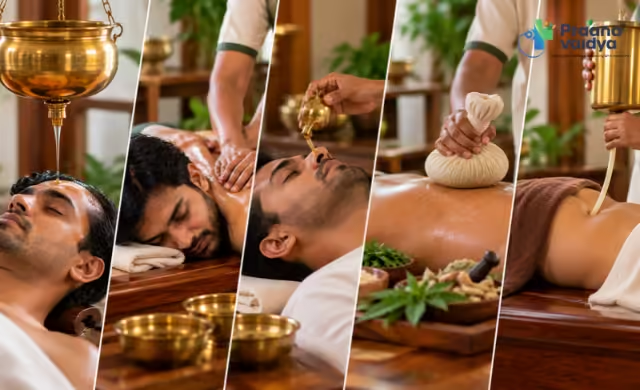
It is also useful to separate Panchakarma from therapies such as Abhyanga, Swedana and Shirodhara. These may be included in an Ayurvedic programme, but they are not part of the classical list of five Panchakarma procedures.
5 Types of Panchakarma Explained
1. Vamana
Vamana is traditionally described as a supervised therapeutic emesis procedure. In simple words, it is a planned Ayurvedic process involving induced vomiting under professional supervision.
The term can sound unfamiliar, especially if you are new to Panchakarma. Vamana should not be confused with ordinary vomiting or with general wellness practices.
It is a specific traditional procedure that forms one of the five classical Panchakarma actions.
2. Virechana
Virechana refers to a traditional Ayurvedic purgation procedure. Simply put, it involves a planned purgative process carried out according to an Ayurvedic programme.
Virechana is sometimes described online using broad terms such as cleansing or detox. However, it is more useful to understand Virechana as a specific Panchakarma procedure rather than a general name for every Ayurvedic cleansing practice.
A Panchakarma programme may include preparation before Virechana and guidance following the main procedure. The details depend on the programme designed by the practitioner.
3. Basti
Basti is another major type of Panchakarma. In simple terms, it refers to the administration of selected Ayurvedic formulations through the rectal route.
You may also see Basti described as an Ayurvedic enema. While that comparison can make the term easier to understand, Basti has its own terminology and traditional Ayurvedic context.
The formulation, method and programme can vary. For this reason, it is better to understand the specific Basti procedure being proposed rather than relying only on a general online description.
4. Nasya
Nasya refers to the administration of selected substances through the nasal route in traditional Ayurvedic practice.
Among the five Panchakarma procedures, Nasya is one of the simplest to describe: it is an Ayurvedic procedure that uses the nasal route.
The word Nasya can appear in descriptions of different Ayurvedic programmes, so the exact process should be explained during consultation. This helps you understand what is planned, how it will be performed and where it fits within the overall programme.
5. Raktamokshana
Raktamokshana is the fifth procedure traditionally listed under Panchakarma. In simple words, it refers to a traditional Ayurvedic bloodletting procedure.
Raktamokshana is distinct from massage, steam therapies and other commonly discussed Ayurvedic practices. Because it is a specific traditional procedure, it should be understood in the context of professional Ayurvedic supervision.
If it is being considered as part of a programme, ask the practitioner to explain the procedure, preparation and overall plan clearly.
Are Abhyanga, Shirodhara and Swedana Part of the Five Types?
This is one of the common points of confusion when people search for Panchakarma.
Abhyanga, Shirodhara, Swedana and Udwartana are well-known Ayurvedic therapies, but they are not included in the classical list of five Panchakarma actions.
The five are:
- Vamana
- Virechana
- Basti
- Nasya
- Raktamokshana
Other therapies may be used alongside a Panchakarma programme depending on the traditional Ayurvedic approach being followed.
Does Everyone Need All 5 Types of Panchakarma?
Panchakarma should not be understood as a fixed five-step package that automatically includes every procedure.
A programme may involve consultation, preparation, selected procedures and follow-up. The practitioner decides how the traditional framework is applied to the individual programme.
This is why the number of therapies in a programme should not be the only factor you consider. It is more useful to understand which procedures are included, how the programme is structured and what preparation or follow-up is expected.
What Are the Stages of a Panchakarma Programme?
When researching Panchakarma, you may come across three traditional terms: Purva Karma, Pradhana Karma and Paschat Karma.
Purva Karma
Purva Karma refers to preparatory steps that traditionally take place before the main procedure.
Pradhana Karma
Pradhana Karma refers to the main stage of the planned Panchakarma process.
Paschat Karma
Paschat Karma refers to the stage that follows the main procedure and includes the relevant post-procedure guidance.
These stages help explain why Panchakarma is often discussed as a programme rather than as a single appointment.
Panchakarma vs Other Ayurvedic Therapies
The terms used in Ayurveda can sometimes become confusing because several therapies may be offered within the same programme.
Here is a simple distinction:
- Panchakarma: The traditional group of five procedures.
- Abhyanga: A traditional Ayurvedic oil massage practice.
- Swedana: A traditional Ayurvedic sweating or fomentation practice.
- Shirodhara: A traditional practice involving the gentle pouring of liquid over the forehead.
- Udwartana: A traditional dry powder massage practice.
Knowing this difference can help you understand what a Panchakarma programme actually includes instead of treating every Ayurvedic therapy as one of the five Panchakarma types.
How to Choose a Panchakarma Programme
If you are comparing Panchakarma programmes, look beyond the number of therapies listed.
Before starting, ask:
- Which Panchakarma procedure is being proposed?
- What does the procedure involve?
- What preparation is required?
- How is the programme structured?
- What is included in the schedule?
- What guidance is provided after the main procedure?
- Who will explain the programme and answer questions?
- Are the costs and programme details clearly explained?
A clear consultation can help you understand the programme before making a decision.
Panchakarma at Praanavaidya
Praanavaidya takes a consultation-led approach to Ayurvedic care, with Panchakarma programmes explained and planned according to the individual assessment.
If you are exploring Panchakarma, you can discuss the available options, schedule, therapies and practical details with the team before beginning a programme.
Praanavaidya has multiple locations across
Rajajinagar- 08065903133
Hubballi – 08065903145
Indiranagar- 08065903135
Mumbai-08065903118
Yelahanka- 08065903134
Mangaluru-08065903136
Jayanagar- 08065903132
Delhi-08065903140
Lucknow-08065903130
Final Thoughts
The five types of Panchakarma are Vamana, Virechana, Basti, Nasya and Raktamokshana. Each represents a different traditional Ayurvedic procedure.
The key is not to treat Panchakarma as a single therapy or assume that every programme includes all five procedures. Understanding the terminology, preparation, main procedure and follow-up can make the process much easier to understand.
If you are considering Panchakarma, start with a consultation and ask clear questions about the specific programme being proposed.
FAQs
What are the five types of Panchakarma?
The five classical Panchakarma procedures are Vamana, Virechana, Basti, Nasya and Raktamokshana. Each refers to a different traditional Ayurvedic procedure.
What does Panchakarma mean?
Panchakarma is commonly understood as “five actions”. In the traditional Ayurvedic framework, the term refers to five specific procedures rather than one single therapy.
Is Panchakarma the same as Ayurvedic massage?
No. Ayurvedic massage practices such as Abhyanga are different from the five classical Panchakarma procedures. They may be included in a broader Ayurvedic programme but are not counted among the five.
Does every Panchakarma programme include all five procedures?
Not necessarily. A Panchakarma programme can be structured around selected procedures, preparation and follow-up. The exact programme is explained during consultation.
What is the difference between Vamana and Virechana?
Vamana is traditionally described as a supervised emesis procedure, while Virechana refers to a traditional purgation procedure. They are two separate Panchakarma procedures.
What is Basti in Panchakarma?
Basti refers to the administration of selected Ayurvedic formulations through the rectal route. It is one of the five classical Panchakarma procedures.
What is Nasya in Ayurveda?
Nasya refers to a traditional Ayurvedic procedure involving the nasal route. It is one of the five procedures associated with Panchakarma.
What is Raktamokshana?
Raktamokshana is traditionally described as an Ayurvedic bloodletting procedure. It is the fifth procedure in the classical list of Panchakarma.
Praanavaidya
Healthcare Professional
Focused on patient-centric care and evidence-based treatment plans.
More from Praanavaidya