An anal fissure can make something as routine as passing stool extremely uncomfortable. Pain during bowel movements, burning afterwards, and fear of passing stool can become part of a cycle that is difficult to break.
In many cases, hard stools and repeated straining are important contributors. When constipation continues, the injured area may repeatedly experience mechanical irritation, making recovery more difficult.
Ayurveda approaches this pattern differently from simply focusing on the painful area. It considers the relationship between bowel function, digestion, dryness, elimination, lifestyle and Vata Dosha.
This is where Basti for anal fissure may have a role in selected Ayurvedic treatment plans.
Basti is a specialised Ayurvedic therapy traditionally associated with Vata management. Depending on the individual’s condition, an Ayurvedic physician may consider it to support bowel regularity, address dryness and difficult elimination, and reduce factors that may repeatedly aggravate the fissure.
Basti is not a universal treatment for every fissure, and its suitability should be determined through professional assessment.
At Praanavaidya, Ayurvedic consultation can help determine whether Basti and other Ayurvedic approaches are appropriate for an individual’s fissure-related symptoms.
What Is Basti in Ayurveda?
Basti is one of the major therapeutic approaches described in classical Ayurveda.
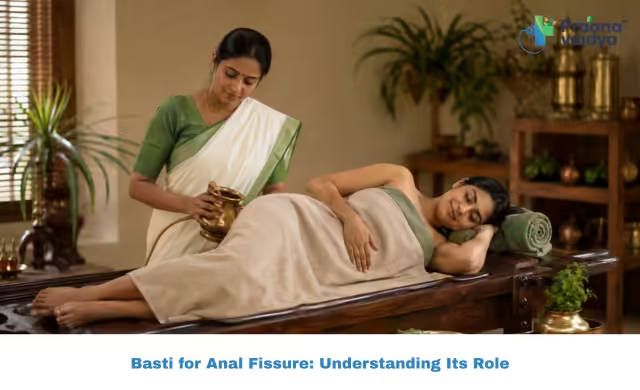
It involves administering a specially prepared Ayurvedic formulation through the rectal route under controlled therapeutic conditions.
Depending on the type of Basti, the preparation may contain ingredients such as:
- Herbal decoctions
- Medicated oils
- Ghee
- Herbal preparations
- Other prescribed substances
Basti is not simply one standard procedure. Different types are selected according to the individual’s condition, Dosha involvement, digestive status, strength and therapeutic objective.
Because it involves the rectal route, Basti should be performed by appropriately trained professionals rather than attempted as a home remedy.
Why Is Basti Considered in Anal Fissure?
To understand why Basti may be considered, it helps to look at the factors that can keep an anal fissure irritated.
A common pattern is:
Constipation → hard stool → straining → anal pain → fear of bowel movement → stool retention → harder stool → repeated irritation
If this cycle continues, the fissure may struggle to recover.
From an Ayurvedic perspective, dryness, hard stool, irregular elimination and pain are commonly associated with aggravated Vata Dosha.
Basti is traditionally regarded as an important therapy for Vata-related conditions.
Therefore, in an appropriately selected person, the Ayurvedic rationale for Basti may be to address the bowel and Vata-related factors surrounding the fissure, rather than simply focusing on the local tear.
How Basti May Help With Anal Fissure
The potential role of Basti can be understood through several aspects of Ayurvedic management.
1. It May Support Easier Bowel Movements
Hard stools can repeatedly stretch and irritate the area affected by a fissure.
When bowel movements become difficult, people may strain, which can further increase discomfort.
Depending on the type of Basti used, Ayurvedic treatment may aim to support more comfortable elimination.
This is particularly relevant when constipation is an important part of the individual’s fissure pattern.
2. It May Address Vata-Related Dryness
Ayurveda associates Vata with qualities such as:
- Dryness
- Lightness
- Roughness
- Irregularity
- Mobility
Hard, dry stools and irregular bowel movements are therefore commonly viewed through a Vata-related framework.
Certain oil-based Basti therapies are traditionally used in Vata-oriented treatment plans.
The aim is not simply to “lubricate the fissure,” but to address the broader pattern of dryness and difficult elimination identified during Ayurvedic assessment.
3. It May Help Reduce Repeated Straining
Straining is an important mechanical factor in many fissure cases.
If passing stool requires considerable effort, the anal region may repeatedly experience pressure and irritation.
By addressing constipation and bowel irregularity, Ayurvedic treatment may aim to make elimination more comfortable and reduce the need for repeated straining.
This can be an important supportive step while the affected tissue is recovering.
4. It May Help Break the Constipation–Pain Cycle
An anal fissure can create a cycle that goes beyond the original injury.
A person experiences pain while passing stool.
Because they expect pain, they may delay going to the toilet.
The stool remains longer in the bowel and may become harder.
Passing the harder stool can then cause additional pain.
The cycle repeats.
Ayurvedic management may therefore focus on improving bowel habits rather than treating pain in isolation.
When appropriate, Basti may form part of this strategy.
5. It May Support Vata Balance
In Ayurvedic theory, Basti is traditionally considered one of the principal therapies for Vata.
Because fissure-related symptoms can include pain, constipation, dryness and irregular elimination, an Ayurvedic physician may consider Vata involvement when developing a treatment plan.
The purpose of Basti is therefore broader than treating a local anal tear.
It is intended to address the individual’s overall Ayurvedic pattern.
How Does Basti Fit Into Fissure Recovery?
Basti is generally not considered in isolation.
Ayurvedic treatment may combine it with measures designed to improve bowel habits and reduce ongoing irritation.
A treatment plan may involve:
Basti therapy
↓
Dietary correction
↓
Improved bowel regularity
↓
Less straining
↓
Reduced repeated irritation
↓
Support for natural recovery
This is the broader rationale behind using Basti in selected cases.
It should not be interpreted as proof that Basti directly closes the fissure.
Which Types of Basti May Be Considered?
Ayurveda describes several types of Basti, and they are not interchangeable.
Anuvasana Basti
Anuvasana Basti is traditionally an oil-based Basti.
Because oil preparations are associated with nourishing and Vata-oriented approaches, an Ayurvedic physician may consider this type when dryness and Vata-related bowel patterns are prominent.
Niruha Basti
Niruha Basti, also known as Asthapana Basti, traditionally involves a formulation containing herbal decoctions along with other ingredients.
Its use depends on the individual’s condition and the therapeutic objective.
Matra Basti
Matra Basti involves a relatively smaller quantity of oil-based preparation and is traditionally used in certain Vata-oriented treatment approaches.
Whether it is appropriate for an individual with anal fissure depends on the physician’s assessment.
What Are the Limitations of Basti?
Basti should not be presented as a guaranteed cure for anal fissure.
A fissure may have causes or complications that require other forms of treatment.
For example, persistent symptoms may be associated with:
- Severe sphincter spasm
- Chronic scarring
- Infection
- Inflammatory bowel disease
- Other anorectal disorders
Appropriate medical assessment is therefore important.
Can Basti Be Done at Home?
No.
Self-administered Basti for anal fissure is not recommended.
The procedure requires appropriate:
- Formulation
- Dosage
- Equipment
- Technique
- Hygiene
- Patient selection
Incorrect administration may cause injury, irritation, infection, or worsening of symptoms.
Basti should therefore be performed only under professional supervision.
How Praanavaidya Approaches Basti for Anal Fissure
At Praanavaidya, Basti is not recommended simply because a person has been diagnosed with an anal fissure.
The Ayurvedic physician may first assess:
- Nature and duration of pain
- Bleeding
- Stool consistency
- Constipation
- Straining
- Bowel frequency
- Appetite
- Digestion
- Diet
- Lifestyle
- Prakriti
- Vikriti
- Previous treatments
- Other health conditions
If Basti is considered suitable, the physician can determine the appropriate type and treatment protocol.
The broader plan may also include dietary guidance, bowel-management strategies, lifestyle changes and other Ayurvedic therapies where appropriate.
The focus is on addressing the factors that may be contributing to repeated irritation while supporting the body’s natural recovery.
Conclusion
Basti for anal fissure is an Ayurvedic approach that focuses particularly on the bowel and Vata-related factors that may contribute to fissure symptoms.
When constipation, hard stools, dryness and repeated straining are present, simply focusing on the painful area may not address the factors that continue to irritate the tissue.
Basti is traditionally associated with Vata management and may be considered in selected individuals to support healthier bowel function and easier elimination. By potentially reducing the factors that contribute to repeated straining and mechanical irritation, it may form part of a broader Ayurvedic approach to fissure care.
However, Basti is not a guaranteed cure and is not appropriate for everyone. The type of Basti, formulation, duration and frequency must be determined through individual assessment.
At Praanavaidya, consultation can help assess the nature of the fissure, bowel habits, digestive factors and overall Ayurvedic constitution before deciding whether Basti or another Ayurvedic approach is appropriate.
Visit Us in-
Rajajinagar- 08065903133
Hubballi – 08065903145
Indiranagar- 08065903135
Mumbai-08065903118
Yelahanka- 08065903134
Mangaluru-08065903136
Chamrajpet-08065903132
Delhi-08065903140
Lucknow-08065903130
Frequently Asked Questions
How does Basti help in anal fissure?
Basti for anal fissure may be considered when constipation, hard stools, dryness, difficult elimination and Vata-related patterns are present. Its traditional role is to support Vata balance and healthier bowel function, which may help reduce repeated straining and irritation.
Does Basti directly heal an anal fissure?
Basti should not be described as directly closing or repairing the fissure. Its potential role is supportive, particularly when bowel irregularity and Vata-related factors contribute to the problem.
Can Basti help with fissure-related constipation?
Basti may be considered as part of Ayurvedic management when constipation is present. The exact Basti type depends on the individual’s condition and should be selected by an Ayurvedic physician.
Is Basti useful for chronic anal fissure?
It may be considered in selected cases, particularly when constipation and Vata-related factors are present. Chronic fissures should first receive appropriate clinical assessment.
Can Basti replace surgery for anal fissure?
Basti should not be promoted as a replacement for surgery. Some chronic fissures require medical or surgical treatment, particularly when conservative management has failed or complications are present.
How often is Basti given?
The frequency varies according to the type of Basti, the individual’s health status and the physician’s treatment plan.
Can I perform Basti myself?
No. Basti is a specialised therapeutic procedure and should be performed under appropriate professional supervision.
Praanavaidya
Healthcare Professional
Focused on patient-centric care and evidence-based treatment plans.
More from Praanavaidya